


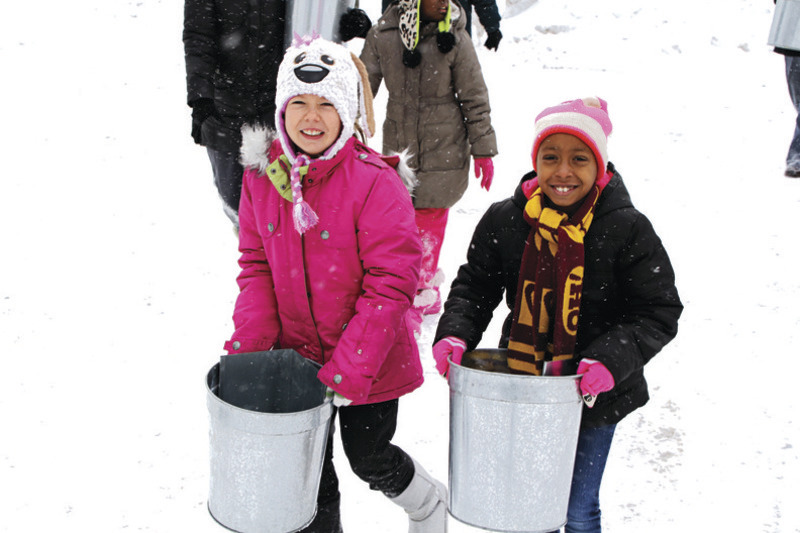
The maple syruping season officially kicked off in Burton Saturday as the Burton Chamber of Commerce held its sixth annual Tree Tapping Ceremony on the village green.
The maple syruping season officially kicked off in Burton Saturday as the Burton Chamber of Commerce held its sixth annual Tree Tapping Ceremony on the village green.
This family-friendly event was a hands-on experience, as visitors from Northeast Ohio were invited to come to the Burton Log Cabin to learn how to tap trees.
After the trees were tapped, participants enjoyed hot chocolate and donuts by the fire in the log cabin.
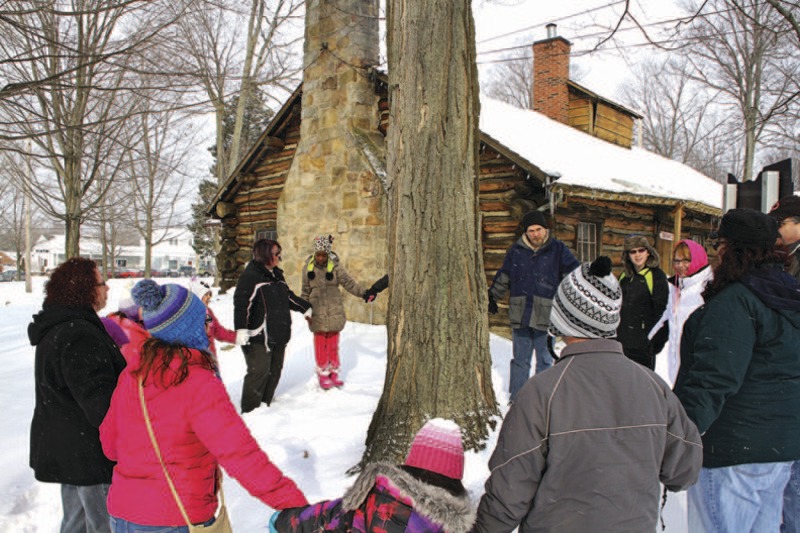
Before the first tree was tapped, however, Amy Blair, the event’s brainchild and the person in charge of retail sales for the Burton Chamber of Commerce at Burton Log Cabin, gathered everyone around a large maple tree as she read a Native American prayer thanking Mother Nature for trees.
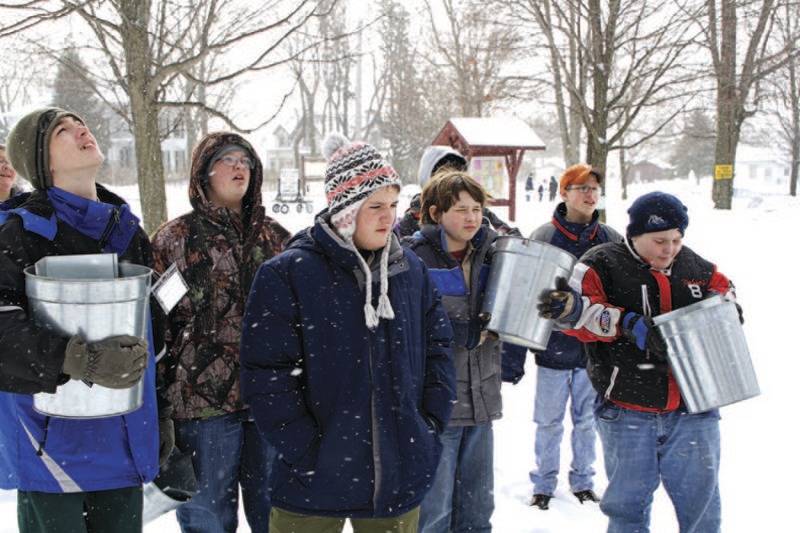
The participants, including members of Girl Scout Troop 70450 in Highland Heights and Boy Scout Troop 112 in Newton Falls, then ventured out into the sugar camp with their bucket, spiel and lid to tap their own maple trees.
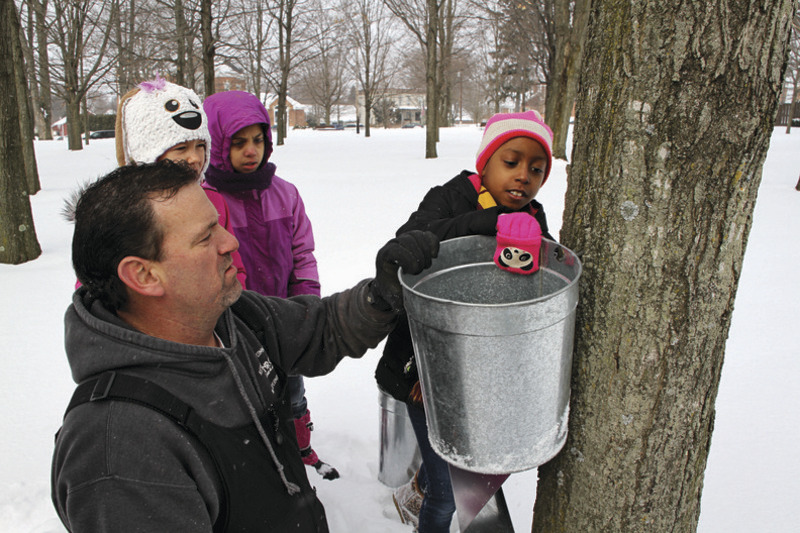
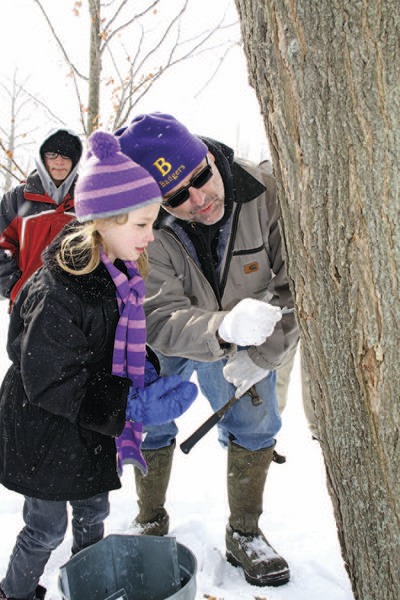
“You’re going to take the drill, you’re going to squeeze the trigger and you’re going to hold it all the way down,” Michael Blair, a Burton Chamber volunteer, told Sanaa Branner, 8, of Troop 70450.
Sanaa next was told to grab her spiel and hammer it into the tree at a slightly upward angle.
“So what happens is, when it gets warm, the sap is going to run down the tree, out of the spiel and into the bucket,” explained Blair, who has been running the Burton camp since about 2000.
After the spiel was inserted into the tree, Sanaa placed her bucket — and name tag — on the spiel and Blair showed her a trick on how to put the lid on.
“You push right in the middle,” he said, demonstrating. “Just like that.”
Sanaa did it.
“Done. You’ve tapped your first tree. Now you can have your donut,” he said, laughing.
A tornado hit the area years ago and wiped out 93 percent of the maple trees in the camp, Blair told the Boy Scouts.
“There used to be about three times as many maples in this park as there are now,” he said. “There also used to be black squirrels here. The storm blew all the trees down and the squirrels actually migrated to Chagrin Falls. That’s a true story.”
He said Ture Johnson, a local forester who worked the Burton camp for some 50 years, worked with The Ohio State University Extension Service to cross bread maple trees, coming up with the “super sweet.”
“The super-sweet maple tree is said to mature in 15 years; it will be 14 inches or larger in diameter in 15 years. Most maple trees take 20 to 25 (years),” Blair said. “The sugar content is supposed to be a half a percent to a full percent higher.”
Sap comes out of a sugar maple tree at about 2.5 percent sugar and syrup is made at about 66.5 percent sugar, Blair said.
“The key to going from the 2 and a half to that 66 and a half is cooking time. That’s why we use an evaporator,” he explained. “But if you start at 3 and a half (percent) as opposed to 2 and a half, what happens to your cooking time? You have less cooking time. That means you’re making a lighter syrup.”
Blair also told the Boy Scouts syrup makers began using a reverse osmosis machine about six or seven years ago, expanding the types of maple trees that could be tapped and increasing the sugar content of the sap even higher — 6 percent up to 25 percent — before it enters an evaporator.
Blair, who retired from the U.S. Army roughly 12 years ago, said he has been tapping maple trees for about 45 years.
“I have the distinct privilege of tapping maple trees that my grandfather tapped when he was a 10-year-old boy,” he said. “He’s 100. So, if anyone tries to tell you that tapping maple trees damages them, tell them to come see me, because I will disprove it.”
He added, “You can over tap a maple tree by hanging too many buckets on it. That will damage a maple tree; it actually will take too much moisture out it. But you need to remember, the sap coming out of a maple tree is a waste product, it’s a by-product.”
Blair further explained only a non-invasive spiel, 5/16th of an inch in diameter, is used to tap a tree.
“What this does is, the maple tree, just like when you cut your hand, heals from the inside out,” he said. “The nice thing about these spiels, when you come back from year to year, the only thing that’s not healed is the outer bark. The inside of the tree is completely healed up.”
Now comes the hard work — collecting the sap and the countless hours, for everyone involved, of boiling down the sap that’s sure to flow.


