


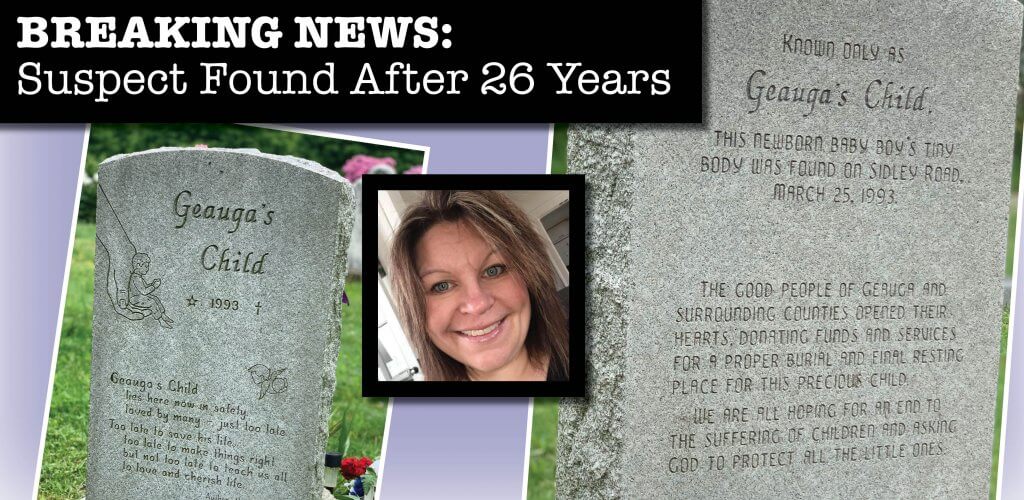
The Ohio Supreme Court announced Sept. 8 it will not accept an appeal in the murder case of State v. Ritchey, known as the “Geauga’s child” case.
The Ohio Supreme Court announced Sept. 8 it will not accept an appeal in the murder case of State v. Ritchey, known as the “Geauga’s Child” case.
The decision follows the 11th District Court of Appeals’ unanimous decision in June to uphold the conviction of Gail M. Ritchey, who was found guilty of murder for dumping her newborn baby boy on Sidley Road in Thompson Township in 1993.
“The Ohio Supreme Court declined to accept jurisdiction today, bringing this case to a conclusion,” said Geauga County Prosecutor Jim Flaiz in a statement. “Our office is pleased that the unanimous decision of the 11th District Court of Appeals affirming the jury verdict and rulings made by (Geauga County Common Pleas Judge David) Ondrey will stand as the final judgment in this matter. I commend the members of the (Geauga County) Sheriff’s Office, both past and present, and the prosecution team for their tireless pursuit of justice.”
Following a six-day trial early last year, a Geauga County jury returned a verdict April 4, 2022, finding Ritchey guilty in the decades-old crime. In May 2022, Ondrey sentenced her to an indefinite prison term of 15 years to life.
“I am pleased with the unanimous decision by the court of appeals affirming the jury’s guilty verdict,” Flaiz had said. “This is the product of the successful partnership between the prosecutor’s office and the sheriff’s office. We will continue to work with law enforcement to seek out justice in Geauga County.”
The appellate court issued its opinion on May 15, 2023, finding each ground of Ritchey’s appeal to be without merit.
First, Ritchey argued the case should not have been filed in Geauga County because she gave birth to the child in Cuyahoga County while working as a nanny for a Shaker Heights family. Ondrey ruled the case was properly brought in Geauga County based on the discovery of the body.
Writing for the appellate court, Judge Matt J. Lynch found Ondrey did not abuse his discretion in holding venue was proper in Geauga County.
“Not only are Ritchey’s statements regarding the birth uncorroborated, but after the passage of almost 30 years they are no longer capable of corroboration,” Lynch wrote.

The court also found the nature of statements Ritchey made during a 2018 interview with a Geauga County Sheriff’s Office detective were “uncertain.”
“Ritchey was not aware she was pregnant for most of her pregnancy. She did not recall when the birth took place except that it was ‘winter.’ Rather than affirmatively stating that the child was stillborn, she claimed not to have noticed if the child moved or made a noise,” wrote Lynch. “She did not know exactly how long the child was in her trunk before abandoning the body someplace she likewise did not know. Given this context, it was not at all reasonably certain that the place of birth was the one detail that Ritchey reported with either accuracy or truthfulness.”
Second, Ritchey argued the expert testimony of Dr. Joseph Felo, the chief deputy medical examiner for Cuyahoga County, should have been inadmissible on a number of grounds, including his testimony did not meet the standards for admissibility and was fundamentally unreliable.
Based on microscopic examination of lung tissue, Felo testified at trial that Ritchey’s son was born alive. Ondrey deemed Felo’s testimony admissible.
“Fundamentally, Dr. Felo’s methodology is sound,” the appeals court found. “There is nothing in the record to contradict the basic premise of his opinion that open air sacs, observed microscopically, are indicative of passive breathing which, in turn, is consistent with a live birth.”
As for whether there are other factors that undermine Felo’s diagnosis, the court held those are questions for the jury to resolve as the trier of fact.
Ritchey also argued Ondrey erred by refusing to allow her attorneys to present evidence of dissociative disorder, a condition that involves a person experiencing a disconnection and lack of continuity between thoughts, memories, surroundings, actions and identity.
Her lawyers sought to present expert testimony to explain why and how Ritchey, after delivery, could transition almost immediately to caring for the children for whom she was a nanny, and on the voluntariness of actions, not mental status.
Prosecutors argued Ritchey did not assert an insanity defense and, therefore, could not offer expert testimony in an effort to show she lacked the mental capacity to commit murder.

The appellate rejected Ritchey’s arguments, finding the former was irrelevant to the issues in the case and the latter to be undermined by her expert’s report.
“On the one hand, the actor is unable ‘to recognize the magnitude and the gravity of the situation.’ On the other hand, the ‘psychological split between body and mind’ creates ‘the sensation of feeling robotic, not in charge of (one’s) own behavior,’” the court stated.
“Given the malleable nature of the evidence, as well as the fact that (the expert’s) opinion is not based on the facts of the present case or any examination of Ritchey herself, it was certainly within the trial court’s discretion to exclude the report and testimony.”
The appeals court also rejected arguments that Ondrey erred in admitting the 1993 autopsy report into evidence and in allowing Felo to testify regarding its contents or express his own opinions of its findings.
Concurring in Lynch’s opinion were Presiding Judge John J. Eklund and Judge Eugene A. Lucci.
Ritchey was arrested in June 2019 after DNA collected from blood and tissue samples from the baby, named Geauga’s Child, eventually led Geauga County Sheriff’s Office detectives to the doorstep of her Euclid home.
For nearly three decades, sheriff’s deputies followed up on hundreds of leads and conducted dozens of interviews in the case, but made no arrests. However, authorities were electrified in April 2018 when a DNA search was used to nab the Golden State Killer, a California man accused of a series of decades-old rapes and murders. Crime-scene DNA samples were uploaded in GEDmatch, a free public online database where hobbyists share their data from consumer DNA testing companies such as 23andMe, FamilySearch.org, MyHeritage.com, FindMyPast.com and Ancestry.com to find relatives with shared DNA and to reverse-engineer their family tree.
Inspired by this new crime-fighting tool, sheriff’s office Det. Don Seamon uploaded DNA collected from blood and tissue samples from Geauga’s Child that had been stored all these years into an online database in an effort to identify both the child and the circumstances surrounding its death. The initial results identified a third or fourth cousin who resided in Warren whose DNA kit was submitted by a family member who was a resident of Nebraska. Eventually, the trail traced their DNA to Ritchey.


