Ohio Tax Debate Sparks Questions About Geauga County Impact
As a grassroots effort to abolish property taxes in Ohio gains traction, so too does the debate over whether it would benefit residents or create new challenges.
This is the first of a three-part series aimed at breaking down how property taxes work, why they exist, as well as examining property tax reform, what has prompted a state-wide movement to abolish them and the potential impact that could have on various entities in the county.
As a grassroots effort to abolish property taxes in Ohio gains traction, so too does the debate over whether it would benefit residents or create new challenges.
Petitions for a proposed constitutional amendment that would eliminate property taxes are circulating in an effort to place the measure on the November ballot. In Geauga County, officials have been proactively examining the potential impacts if the amendment passes.
The Abolitionists
Brian Massie, of Concord Township, said his concerns about property taxes began about a decade ago.
“It really started very innocently when I looked at my own property tax bill and in the 10 years I lived in Concord Township, the property taxes had gone up 40%,” he said.
Massie said he began educating himself about property taxes and later sought to inform others about the system, particularly after the 2023 revaluation.
He described a history of reaching out to state officials about property tax relief and feeling ignored, which ultimately led him to pursue a constitutional amendment.
“We said we’re just going to have to eliminate property taxes altogether,” he said.
Massie is now spearheading the “Axe the Tax” movement in Ohio, which seeks to abolish property taxes statewide.
To place the proposed amendment on the November 2026 ballot, Massie must collect 413,488 valid signatures from registered voters by July 1.
He declined to tell the Geauga County Maple Leaf how many signatures have been gathered so far.
“Senator Jerry Cirino has declared war on the people of the state of Ohio, he and Matt Huffman,” Massie said. “When you are at war, you never give the enemy any intel. There’s only one person in the state of Ohio that knows how many signatures we have and that’s me, yours truly, Brian Massie, and I’m not telling them a thing.”
Massie said his concerns about Ohio’s current property tax system are varied. Among them, he believes the government should not be responsible for property valuation, the public sector has outgrown the private sector’s ability to fund services and state legislators are limiting resources available to local communities.
“We say any tax causing a citizen to become homeless is immoral,” he said.
Although the language of the proposed constitutional amendment is brief, Massie said it had to be written that way.
“It could only be one item on the amendment,” he said. “We could not have multiple items like, ‘Lets not have property taxes for payment of schools,’ or ‘Lets cap it for this or that.’ Any time we were to introduce anything other than the abolishment, it probably would not have been accepted by the attorney general and the ballot board.”
While some people have suggested raising sales tax to replace property tax revenue, Massie said the government needs to reduce spending first.
“We’re talking about trying to reduce the size and cost of government through cost-saving measures,” he said. “We’re not replacing dollar-for-dollar. First and foremost, we say cut the spending.”
The movement has drawn concern from residents and officials about losing local control, but Massie questioned how much local control actually exists.
“Everybody thinks we’ve got local control of the schools,” he said. “I’m not sure about that. I’ve been to school board meetings I don’t know how many times. You’ve got three minutes (to speak) and not a second more, nobody answers questions. We don’t have any control over anything.”
If property taxes are eliminated, Massie said the state would need to assist entities that rely on that revenue to operate.
“They’re assuming that the state is not going to do anything at all on the local government front,” he said. “I’m saying that it is incumbent upon all of our local officials, be they trustees or council people to talk to their representatives at the state level to say, ‘Something has got to change.’ They cannot keep all the money at the state level.”

The Proposed Ballot Language
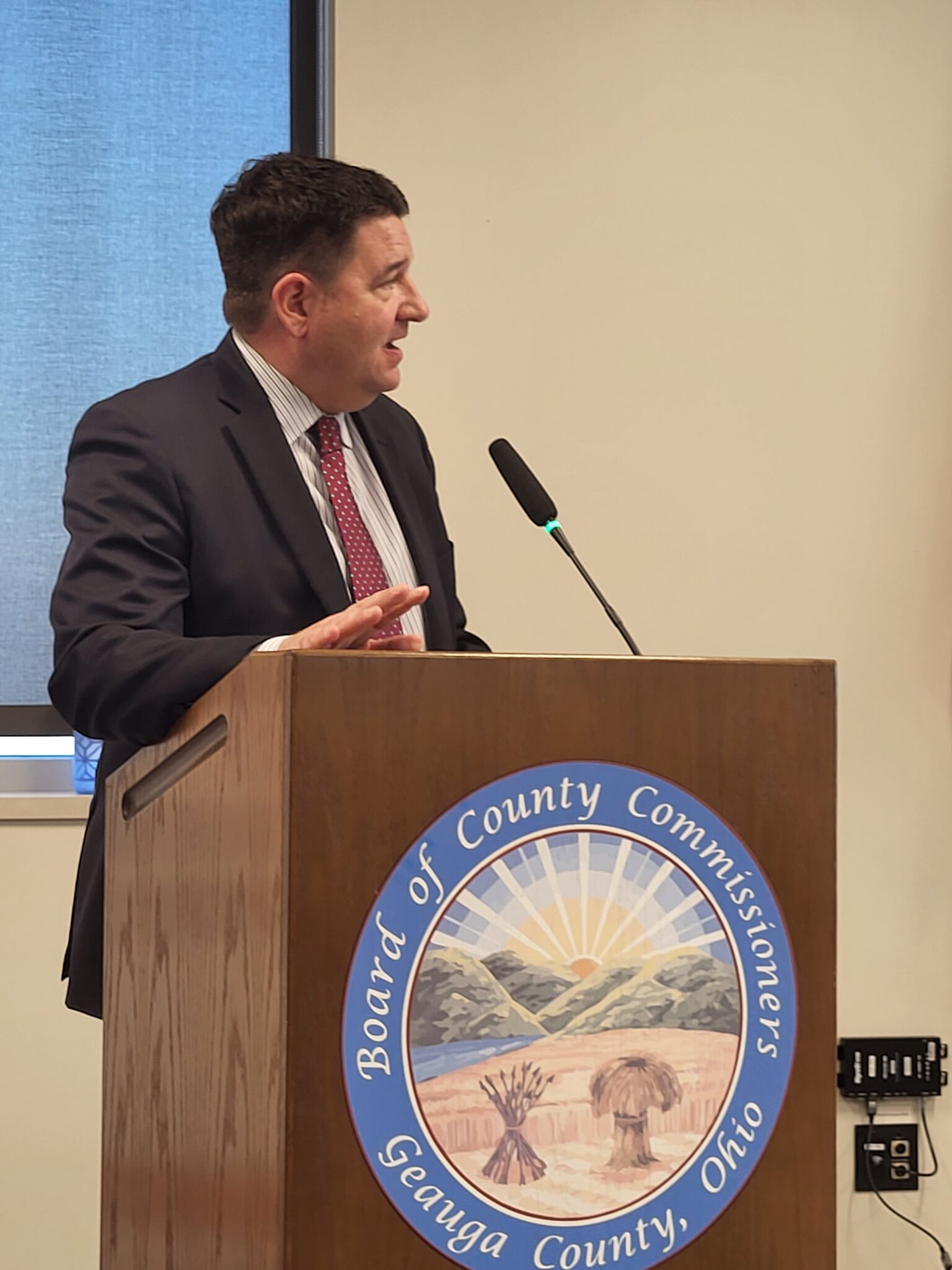
The proposed amendment’s language is straightforward, Geauga County Prosecutor Jim Flaiz said during an informational forum March 10 at the county office building in Claridon Township.
“This abolishes all real property taxes,” he said. “No taxes will be imposed on real property and no other provision in the constitution shall impose taxes on real property.”
Some property taxes are imposed by the state constitution, which also guarantees certain funding commitments, including those for schools, Flaiz said.
The amendment would eliminate all property taxes, not just those affecting seniors or owner-occupied homes, he emphasized.
“Home Depot would not pay any more property taxes and they are a big stress on our county resources,” he said. “You’d be surprised how many times the ambulance goes to Walmart or the shopping centers. All of those real estate taxes would be gone that support those local services.”
When the amendment — if it passed — would take effect is somewhat unclear, Flaiz said, noting property taxes are collected in arrears. Based on the language, however, he believes the change could be immediate.
Numerous lawsuits would likely follow because contractual obligations remain even if the funding source disappears, he added.
Property Tax and the County
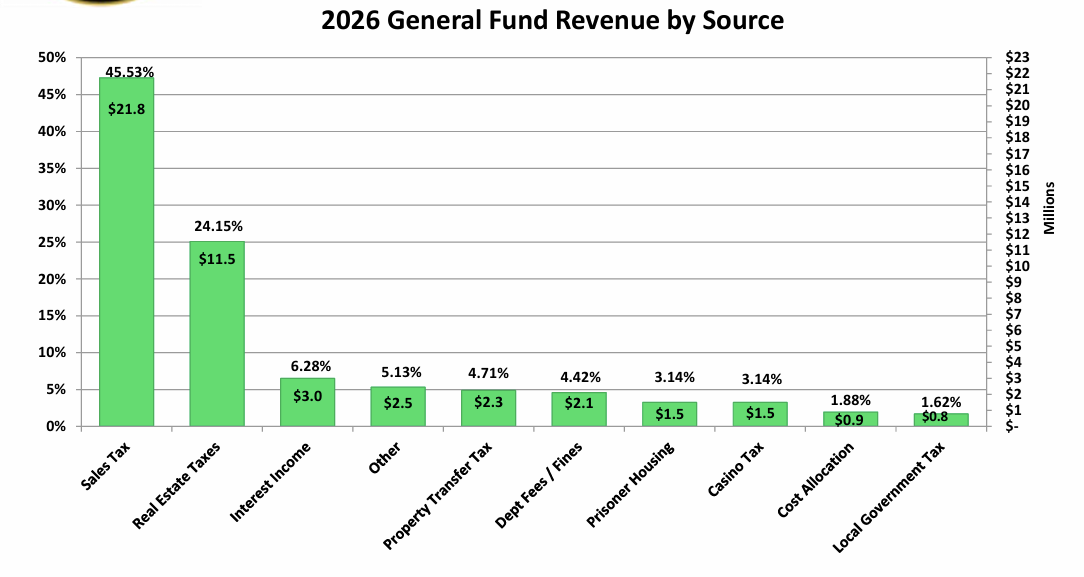
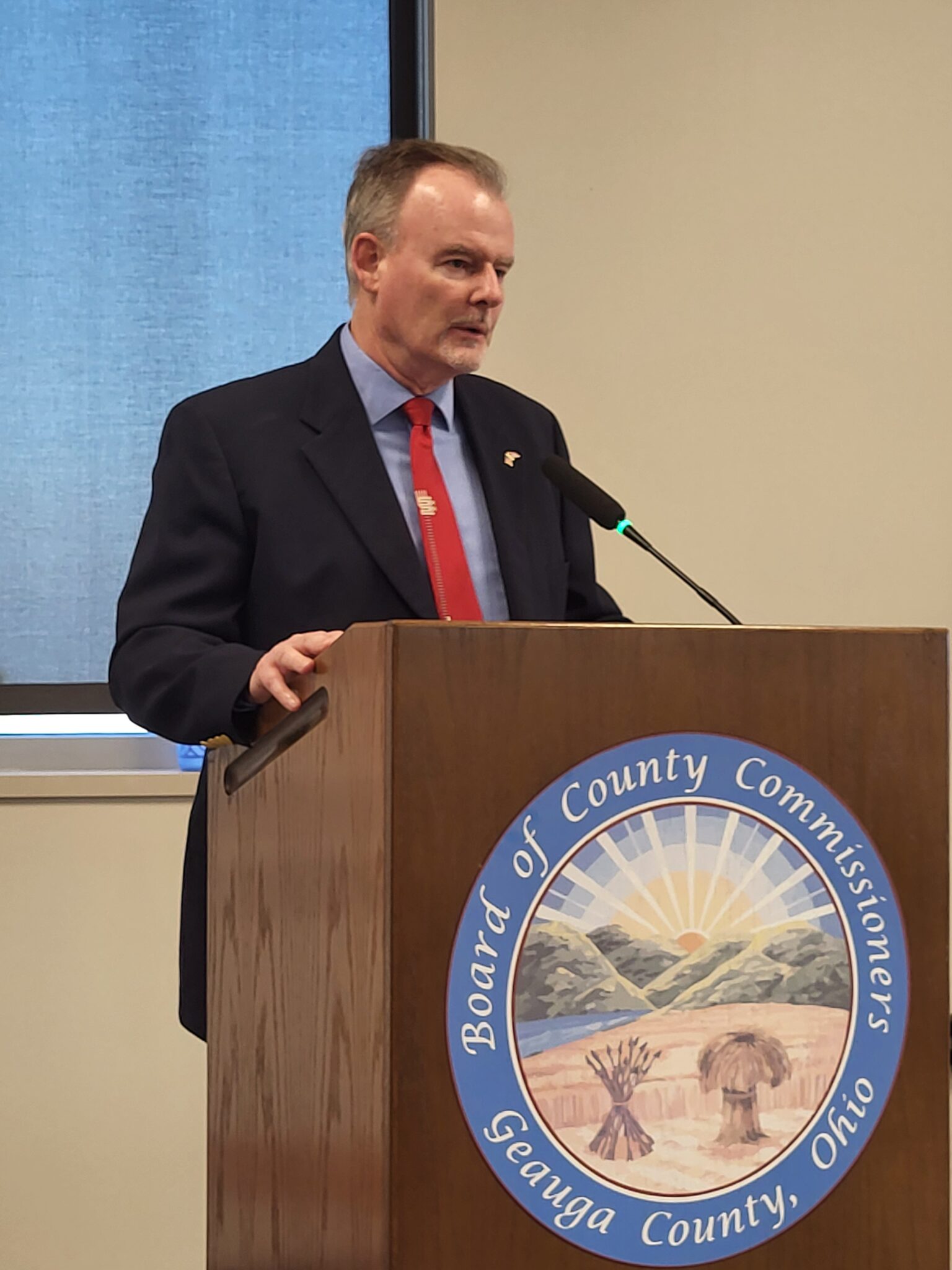
Property taxes account for about 24% of Geauga County’s general fund, Geauga County Commissioner Carolyn Brakey said.
The general fund supports every countywide elected office, all of which are required by statute, she explained.
Some departments also receive funding through levies. For example, Geauga County Job and Family Services has two levies and the county Department on Aging has one, Brakey said.
Other county entities, including the department of water resources, the dog warden and building department generate revenue through service fees, she said.
“What’s left over, of the departments under the commissioners, is the department on aging, which, I believe none of that is statutorily required,” Brakey said. “That’s the Meals on Wheels programs and then also a lot of the programs I think provide a sense of community for the aging population, but those things are not required by statute.”
If property tax revenue disappeared, the general fund would not be able to absorb the additional demand, Brakey said.
“The main source of income for the general fund is sales tax (at 45.5%). And that is something that we, as commissioners, could increase by statute,” she said. “We’re at 6.75% now. Of that, only 1% goes to the county, 5.75% goes to the state.”
Although the county could legally increase its sales tax to 8%, Brakey said she would prefer not to, noting consumer spending behavior could change if rates rise.
Fees and fines could also be increased, but many are set by statute, leaving less wiggle room, she said.
Eliminating property taxes would mean losing nearly a quarter of the county’s budget, Brakey said.
“We couldn’t just absorb the townships and still maintain the same level of services we are providing now,” she said.
In that scenario, the county would likely need to make drastic cuts, beginning with services that are not required by statute, she added.
Shared-service agreements — such as those between Geauga Public Health and the Lake County General Health District, or between Geauga Transit and Laketran — could become more common, Brakey said, adding similar arrangements could potentially apply to fire, police or school districts.
“We’re still able to have local control with sharing services and saving money,” she said. “With the health department in particular, why the health department is able to save about half a million dollars a year with that agreement is because all of those statutorily required upper-level management positions are shared between the two counties.”
Looking at ballot issues over the past two years, levies in Geauga County have largely passed, said Geauga County Auditor Chuck Walder March 10.
“My worry is, we’re not just getting rid of levies we didn’t want, like inside millage and the 20-mill floor,” Walder said. “We’d get rid of everything, including the ones we voted for.”
Flaiz added that only a small number of foreclosures filed in the county are tax-related, though such cases do occur.

Possible Impact
In a Feb. 19 interview, Walder estimated his office could shrink by about 25% if property taxes were eliminated, primarily affecting reappraisals, the budget commission and the board of revision.
Brakey said she believes abolishing property taxes could shift more power to the state level.
“Property taxes are the primary way that local governments have to fund services and make decisions locally,” she said. “So, to the extent that revenue source would disappear, then local entities would then become dependent on the state, more dependent on the federal government to make up that funding and that funding typically comes with strings attached.”
Local officials would also be forced to make difficult decisions the public may not like, such as determining which services are essential and which could be consolidated, she said.
Brakey said the county’s property tax abolishment response task force is also examining potential job losses.
“I think it would be massive job abolishments for any folks that are providing services that aren’t statutory,” she said.
Two-thirds of Geauga County Public Library’s funding comes from property taxes, said Director Kris Carroll.
“We would have to cut our services by two thirds and that would include staff and possibly buildings,” she said.
Flaiz also noted possible impacts to law enforcement.
“(Roughly) 45%, maybe a little less, of our cases county-wide are through the sheriff’s office,” he said. “Which means, 55%-plus of our criminal cases come from all those other police departments. All those other police departments are 80-90% funded through property taxes. They would be gone.”
That could require the sheriff’s office to significantly expand patrols and staffing, or result in fewer cases being pursued, he said.
“I don’t think crime would go down, but we certainly would be catching a lot less of it because our law enforcement resources would be reduced over 50% in the county,” he said.
Property taxes make up about 27% of the Geauga County Engineer’s Office’s revenue, said Administrator Steve Yaney, noting that by law, those funds can only be used for infrastructure.
Because state and federal grants often require a local funding match, losing property tax revenue could also reduce his office’s ability to pursue grant-funded projects, he added.
Geauga Public Health receives about 17% of its funding from property taxes, Geauga Health Administrator Adam Litke said.
“It is important to understand that if levy funding is not secured, the alternative method for funding these essential public health services involve a direct assessment to our local subdivisions — our townships, cities and villages,” Litke said. “This would shift a significant financial burden directly onto local municipal budgets, potentially impacting other local services.”
Geauga County Mental Health and Recovery Services funds programs through grants to a variety of service providers, Executive Director Christine Lakomiak said.
Those programs operate on a $7.3 million budget, nearly $4 million of which comes from two levies, she said.
Meanwhile, 79.4% of the department on aging’s funding comes from a levy, with the rest from grants, fees and donations, said Director Jessica Boalt.
The levy supports services including home-delivered meals, case management, medical transportation and legal services, she said.
The Bessie Benner Metzenbaum Center in Chester Township would likely be unable to continue operating if property taxes were eliminated, the organization said in a statement.
“Unless a new, stable local funding source is in place by 2028, the Geauga County Board of Developmental Disabilities will effectively cease to exist and 1,200 people with developmental disabilities will be left without vitally important support to live, learn and earn in our community,” officials said.
State Sen. Sandra O’Brien said the state would likely not be able to replace the lost funding.
“We’re trying to discuss it and think of what might be done, but you can’t take all that money and move it to the state,” she said. “We can’t afford it. That’s not going to happen. Maybe we’ll help a little bit, but we can’t fill that hole.”

Relief Efforts
While gradual, some property tax relief efforts have occurred at the local and state levels.
Over the past five years, the Geauga County Budget Commission has returned approximately $16 million to taxpayers from entities who could not demonstrate adequate need for the funds, Walder said.
“This year alone, based on a recommendation by the budget commission, the board of county commissioners suppressed one (Geauga County Job and Family Services) levy. I think that was $1.7 million,” he said.
Commissioners took similar steps when the 2023 revaluation took effect, as did several townships.
At the state level, O’Brien said lawmakers recently approved four major reforms.
“We prioritized property tax relief for Ohioans who own and live in their homes,” she said. “So homeowners will see the owner-occupied — or we call it the residential tax credit — increase over the next four years. This will provide an additional $350 million to $400 million of property tax relief for Ohio homeowners.”
The automatic growth of inside millage has also been capped so it cannot exceed the cumulative inflation rate over the previous three years, she said.
Additionally, county budget commissions now have expanded authority to reduce unnecessary or excessive collections, she said, and many existing emergency and substitute levies are subject to the tax reduction factor.
Several officials agreed Ohio’s system still needs reform.
“I think Ohio has made it so easy to ask for money from taxpayers first, rather than push the agenda (that) we should ask the taxpayers for money last,” Walder said. “We should do everything we can to squeeze the money until there’s no other alternative but to ask for more.”
Requiring 66% voter approval for levies could also reduce how many are approved, he said.
Taxes in general need a system overhaul, Brakey said at the informational forum.
“I think we need to look at this as a more holistic problem,” she said. “I think that starts by letting our taxes stay more locally, preferably in your pocket, but to the extent that you are being taxed, I think that should stay within our county.”
Part two of this series will look at how property taxes work in villages, townships and cities, and examine the potential impact abolishing them could have on local services and department operations.