


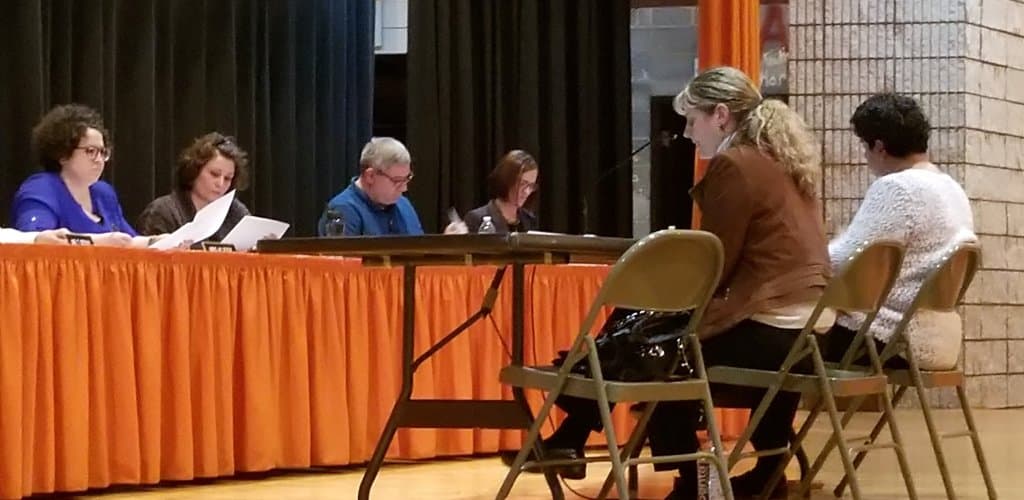
“We’re not here to poke holes, but to make informed decisions.” – BOE President Maggie Zock
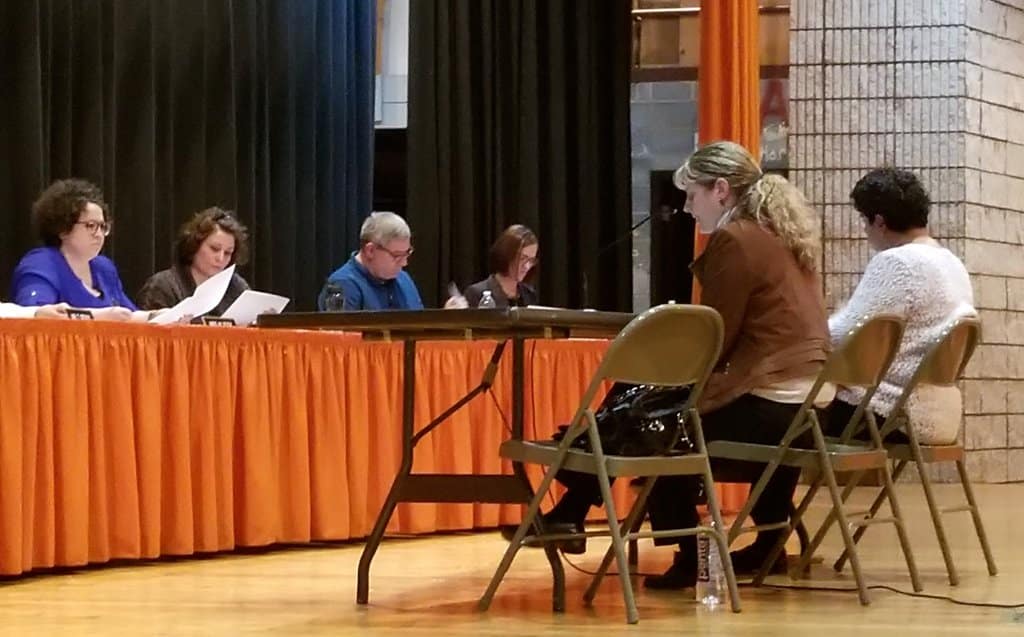
This story has been updated to reflect additional information and a clarification regarding projected budget deficits.
A team of specialists from the Ohio Auditor of State’s office told Newbury Schools Board of Education members Tuesday that without two levy renewals, the district would face budget deficits starting in fiscal year 2022.
Board President Maggie Zock explained later the board invited the team to look over district Treasurer Nancy McPeak’s budget projections over the next five years to help the board make an informed decision about when renewal levies should be placed on the ballot.
Two emergency levies, a 7.7-mill, 10-year levy that raises $1,356,000 annually and a 10-year, 6.8-mill levy that yields $1,200,000 annually, are set to expire in 2019, with collections ending in 2020.
In January, a divided board rejected McPeak’s recommendation that it place the levy renewals on the May ballot because it historically takes several attempts to pass school levies in the district.
McPeak said without the renewals, the district would stop collecting $2.5 million in January of 2020.
At that meeting, board member Kimya Matthews said she could not support asking for levy renewals until she was convinced the district does not have a rumored $3 million surplus in its general fund.

At Tuesday’s meeting, state auditor local government specialists Tisha Turner and Nita Hendryx presented board members with a 15-page report that showed a budget deficit of $830,000 in 2020, $2 million in 2021 and $2.2 million in 2022.
Hendryx explained they found the numbers McPeak’s office supplied were “spot on” and the state audit report did not include any salary increases, changes in staffing levels or additional capital outlay because there were no upcoming projects approved by the new board so far.
“And you are not taking into account the rate of inflation or the consumer price index,” McPeak said.
“Correct,” Hendryx replied.
Hendryx added she and Turner had compiled their conclusions from McPeak’s figures, information from the Geauga County Auditor’s Office and financial projections from the Ohio Department of Education.
Zock said the board needs a list of capital projects that would be needed during the next five years.
“We need to be able to make financial decisions based on accurate information,” she said.

Board member Marty Sanders said the previous board had a list of facility improvements that were needed, including $1 million for new windows, but had put the list on hold during consolidation talks and later because a new board would be chosen in the November 2017 election.
“The building looks like an old factory,” Sanders said. “Also, you have to make assumptions that the staff is going to get a 1 percent or 2 percent raise.”
Sanders added it is difficult to make accurate predictions about needed repairs and upgrades because things can break down unexpectedly.
“One year the well went and that almost got us in (financial) trouble,” Sanders said. “We had to truck in water which was expensive.”
“You plan projects, then something happens,” added board member Kirk Simpkins. “It’s easy to sit back and poke holes.”
Replied Zock, “We’re not here to poke holes, but to make informed decisions.”
McPeak said she will make another budget projection in May and would discuss the financial situation further at the next board meeting, on April 16.
McPeak thanked Turner and Hendryx for their professionalism and the accuracy of their report.
The board took no action and did not take any public comments from the sparse audience of about 75 people scattered throughout the auditorium.
The 90-minute meeting adjourned at 8:35 p.m.
Wednesday, Zock told the Geauga County Maple Leaf the auditor team projected that deficit spending will begin by 2020, but cash accrued from levies means the district will not face general fund deficits until 2022.
Zock said the board needs to examine the school facility and determine what capital projects will be needed during the next five years, then discuss their findings with the community before deciding whether, or when, to place levy renewal issues on the ballot.


