


The event was shortly before Easter weekend and the setting was a busy section of state Route 166 in Thompson Township.
The event was shortly before Easter weekend and the setting was a busy section of state Route 166 in Thompson Township.
Megan Ritts had just moved into a home she purchased in the country. It was across the street from an abandoned farmhouse, completely overgrown with a broken-down barn in the back.
On the beautiful spring day, Ritts and her fiancé, Jake Schafer, glanced out front to see what they thought was a fox, coyote or a goat.
They wondered what such a thing would be doing wandering around in the daytime near a busy road.
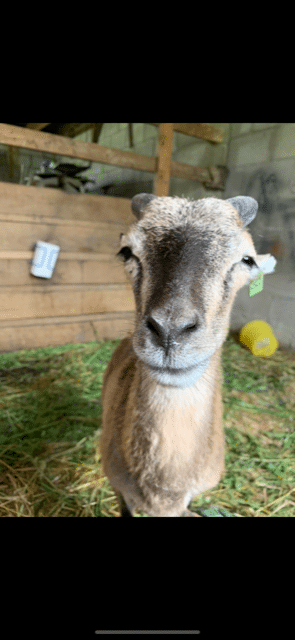
After days of this mysterious visitor appearing, closer examination revealed a male mangy baby lamb about 8 weeks old — not something lost on a Christian couple just before Easter Sunday.
Ritts realized he was hungry and went over to feed him. Skittish and frightened, she could only get within three feet before he would bolt, she said, adding the lamb, which they affectionately called “Goat,” took refuge in the abandoned barn across the busy road.
“I had to do something to help,” she said. “I just felt bad since he was sitting there all alone. He might have been some kids’ 4H project.”
Goat would cross the street daily around 11 a.m. to come to graze on the fresh grass at Ritts’ house. Thinking he must need more, she bought special sweet feed to be a good adoptive parent until she could find out who the baby belonged to.

Plying Goat with honey nut Cheerios, Ritts coaxed him to cautiously tread across the road to more solid food, but he was very suspicious and often ran recklessly back across the busy street to seek the security of the barn.
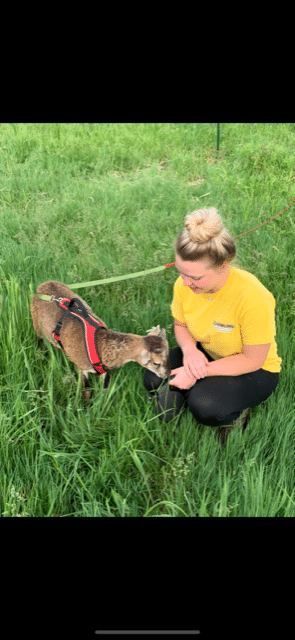
Fearing for his life, Ritts and Schafer invested in a failed attempt at a collar and leash, later purchasing a more substantial and well-tolerated harness.
The couple saw a green tag with #58 attached to Goat’s ear — a foreign identification that took two months to decipher.
After asking 4H friends, area veterinarians and posting a notice on a goat Facebook page, Ritts received information that perhaps the sheep was a Soy Sheep from the Netherlands. She and Schafer did research on this breed and Schafer even went so far as to join a Facebook Soy Sheep page to get leads on how to get the lamb back to its rightful owner. The couple also wanted to be sure they were feeding Goat properly, since various breeds require different feed.
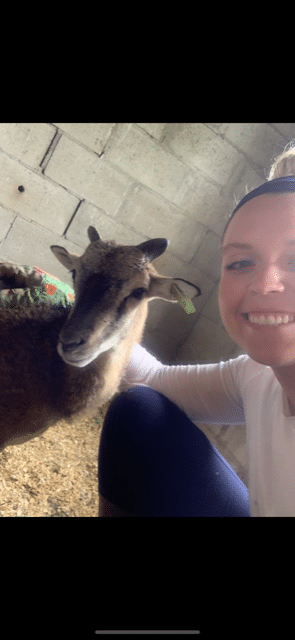
Ritts and Schafer were becoming attached to Goat. So, although they walked Goat daily and allowed him to graze and bask in the summer sun, the couple realized they must find Goat’s rightful owner.
“He was a lot to handle because he was supposed to be with a group. He was not happy and kept freaking out,” Ritts said.
As a last resort, the couple reached out to a shelter for abused and rescued farm animals three hours from their home. But the feelers were still out. Ritts’ soon-to-be-mother-in-law, Lisa, asked a fellow teacher in the off chance someone would know something.
Lo and behold, someone on the southwest side of Thompson had, indeed, lost a baby lamb they purchased for breeding stock.
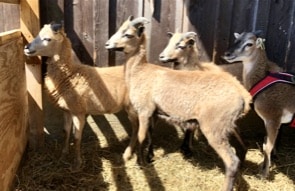
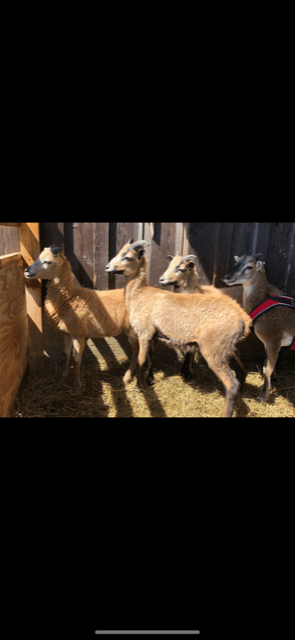
Goat was actually a Barbados Black Belly Sheep. The family, who wished to remain anonymous, had purchased two males and two females to raise this breed for sale.
Their young daughter thought it was appropriate for sheep that were going to mate to be married. So, she was preparing a wedding for the baby lambs — with veils, bow ties and all.

As she zigzagged in and out of the pen preparing for the big event, Goat, a mere 6 weeks at the time, ran off.
Ritts discovered the Barbados Black Belly breed is known for its hearty nature, its resistance to disease and its mild flavor when butchered. It is also a breed that does not need to be shorn, making it an easy keep.
Goat’s original name was Clover and he had traversed some 1,600 acres of woods — or perhaps four miles as the crow flies to find his temporary home.
Upon reuniting with his pen mates in June, there was some ramming and scrapping for dominance, but Clover has assimilated well to his original home.
His owner, however, did ask Ritts if she wanted to keep him.
“(I said) I can’t keep him unless I have two of them,” Ritts recalled. “And then if he’s still unhappy, I’ll have two of them!”


