


Incumbent Geauga County Auditor Charles Walder is facing a challenge from state Rep. Diane Grendell, R-Chester Township, for the Geauga County auditor seat in the May 3 primary election.
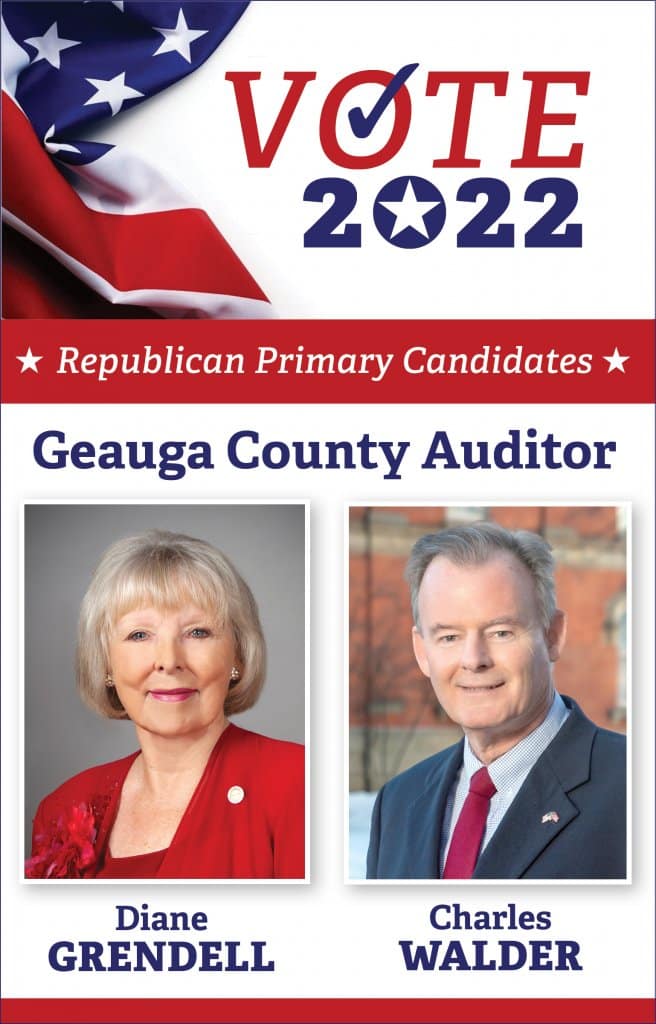
Incumbent Geauga County Auditor Charles Walder is facing a challenge from state Rep. Diane Grendell, R-Chester Township, for the Geauga County auditor seat in the May 3 primary election.
The four-year post, which will begin March 3, 2023, pays an annual salary of $96,589, according to the Geauga County Auditor’s Office.
According to the Geauga County Board of Elections, 67,315 people are eligible to vote in the race as of April 25.
Following are the candidates unedited and complete answers to questions the Geauga County Maple Leaf editorial staff posed to them.
Candidate Name/Age: Charles E. Walder / 66
Occupation/Employer: County Auditor/Geauga County also General Partner/CK Properties, Ltd.
Education: BSME/EE – General Motors Institute (now Kettering University)
Campaign Website: www.ChuckWalder.com
Candidate Name/Age: Diane V. Grendell
Occupation/Employer: State Representative, 76th District/ State of Ohio
Education: Juris Doctor Degree, BBA Business, BA Psychology, Registered Nurse
Campaign Website: www.dianegrendell.com
1. Why are you running for election as Geauga County Auditor? What are your motivations?
Grendell:
Several people unhappy with the current Auditor’s behavior asked me to run, and when the Ohio Supreme Court ruled (7-0) that Auditor Walder failed to perform his legal duties, I decided to apply my public finance, business, and law experience to serve as County Auditor in compliance with the law, without wasting taxpayer money, and while treating everyone who interacts with the Auditor’s Office with respect and professionalism.
Walder:
I am running to continue the work I began 4 years ago, when appointed and elected Auditor, in the wake of a 9-year, $1.8m embezzlement by the IT Director.
My motivation is to improve local government and serve taxpayers by ensuring that all county entities follow generally accepted accounting principles; lawfully certify, appropriate, and expend money from the Treasury; and hold taxing authorities accountable for demonstrating need when budgeting your money. I will continue to do this without favoritism, partisanship, or personal gain.
2. County auditor is the chief fiscal officer of Geauga County. Please state your professional experience with accounts payable, payroll, preparing monthly, quarterly and annual financial reports, licensing, weights and measures, and calculating tax levies?
Walder:
For 38 years I have been the CEO/CFO of my own company dealing with all financial aspects of cost-accounting including payroll, accounts payable/receivable, inventory control, and tax filings. I am intimate with annual W-2/1099 issuance, federal, state, and local tax filings, deferred compensation plans, retirement plans, and the myriad of other accounting requirements.
From 2013 until my appointment as Auditor, I was a township fiscal officer. I learned fund-based accounting principles, produced annual financial notes and reports, and Hinkle reporting. I prepared tax levies and receipted/reconciled tax distributions from the county and state, processed grants, and loan/bond initiations.
Since 2018, I have administered employee 457 plans, prepared comprehensive and popular annual financial reports, and grant and asset reports. I am responsible for certification of tax levy rates/amounts for all county taxing authorities. I understand and currently administer Geauga County’s vendor, cigarette, and dog licensing and oversee our weights and measurements program for fuel pumps and scales, with their required inspections, certifications, and reporting.
Grendell:
I have more experience now than the current Auditor did upon entering office. Having run two successful businesses, I have daily experience with accounts payable, payroll, preparing monthly, quarterly and annual financial reports, and my Business Administration Degree included 4 years of intensive accounting education.
As a nurse, businesswoman, attorney, and Legislator, I have been intimately involved with detailed licensing issues, and as an Appellate Judge, I decided cases involving licensing issues.
As a bakery owner, I was constantly calibrating scales and other measurement-taking devices to ensure ingredient accuracy for product consistency.
As an Appellate Judge I decided cases regarding taxes, levies, and related issues, and as a Legislator I have been involved in multiple legislative matters regarding tax and levy issues, requiring a sophisticated understanding both of current law and effects of a change in the law.
3. As county auditor, please explain how you have or would make county government more transparent and accountable for residents’ tax dollar?
Grendell:
I will provide individual property owners with ALL supporting documentation used to determine their property values, including comps and formulae, and will appoint an ombudsman who property owners can contact with questions or concerns.
Unlike the current Auditor, I will not waste tax dollars misusing the official County Auditor government website and social media to mislead the public for personal or political reasons, and will treat all public offices fairly, not inviting unnecessary litigation under the guise of “public transparency.”
As an experienced Legislator and former Appellate Court Judge, I will make all county finance records fully accessible to the public in accordance with Ohio Law.
Walder:
Increasing and improving government transparency and accountability is a work in process.
My Office makes all Budget Commission, Board of Revision, and Automatic Data Processing public meetings available virtually along with making available public comment/questions.
To keep the public informed, our website now makes publicly available high-interest records to fight misinformation and provide factual data to taxpayers of communications, bills, and payments.
To increase transparency in the hearing process, my real estate/appraisal Office notifies local governments about Board of Revision complaints filed by school districts against property owners in their area and possible outcomes affecting their tax-base.
4. A duty of the county auditor is to assure every parcel of land and any buildings thereon are fairly and uniformly appraised, and then assessed for tax purposes. How have you or would you fulfill that duty?
Walder:
One of my most important duties is accurately and fairly setting property values. My Office performs our triennial and sexennial updates using a contracted, non-biased, independent, certified mass appraisal firm. This process removes favoritism and prejudice and follows defined appraisal methodologies for fairness and accuracy.
Operating the Board of Revision in an un-biased, transparent, and balanced manner allows owners to challenge valuation by presenting evidence. By following case-law, the BoR applies consistent, fair, and uniform valuation determinations.
Grendell:
Unlike the current Auditor, I will hire qualified in-house appraisers familiar with local property value trends to ensure that property tax valuations are as low as legally possible, instead of outsourcing elsewhere; will provide property owners with ALL supporting documentation used to determine their property values, including comps and formulae; and will appoint an ombudsman who individual property owners can contact if they have questions or concerns about their property taxes.
I will also conduct a series of public meetings offering property owners opportunities to obtain information about the appraisal process, and to obtain their input to ensure that the process is as fair as legally possible.
I will make the Board of Revision property-owner friendly.
5. The Geauga County Auditor’s Office has a new website accessible to the public. What improvements, if any, would you make to the site?
Grendell:
I would first remove all political propaganda published by the current Auditor, then publish a TRUE public transparency page providing easy access to the Ombudsman, listing local tax levies and tax rates so residents can verify their own taxes, and inform the public of educational and informational opportunities, including a schedule of free educational seminars.
Walder:
My first objective was to migrate from DotNetNuke to the modern and safer WordPress. My second objective was to make the websites mobile friendly to accommodate today’s users. Lastly, to modernize appearance, make navigation easier, and more intuitive.
We have accomplished these goals but modern websites are never “done,” they require constant improvement. Therefore, we have modularized the website with re-useable code. Other county websites can then reuse the modules with minimal cost and conversion requirements, saving time/money.
I plan to facilitate more data mining capability so taxpayers can obtain commonly requested data 24/7. Our central data repository will broker that data and provide secure isolation from our network.


6. How can or should the Geauga County Auditor’s Office provide resources and work with clerks and fiscal officers to perform their duties and render services to their residents?
Walder:
Fiscal Officers/Treasurers are unsung local government heroes. Our jobs are complicated, detailed, and underappreciated, yet we are held personally liable for money we oversee.
I feel a responsibility to provide support and assistance to these hardworking, dedicated individuals. For the first time in Geauga, I have created a specialized team to work directly with fiscals/treasurers. Answering their questions, helping with issues, providing feedback on submissions, and listening to their needs. We are from their world and understand their challenges and stresses.
We developed training for fiscals/treasurers on proper use of CARES Act money, Budgeting, and Special Improvement Districts. We are working on additional training for Reserve Fund establishment and ARPA money use.
With the County Prosecutor, I created ballot forms simplifying the levy process while reducing error. We provide fiscals/treasurers with early warning notices of budget issues, giving them opportunity to resolve issues before deadlines.
Grendell:
Unlike the current Auditor, I will treat all clerks and fiscal officers equally and respectfully, recognizing they are each either elected officers themselves or employed by elected officers, entrusted to perform important public financial functions. I will work with them to help them protect the tax dollars entrusted to them.
Upon request, I will provide training and assistance as needed. I will notify them in advance of any issues so they can be prepared to address them, instead of ambushing them. I will also not demand access to personal computers for government purposes.
7. Under Ohio law, can a county auditor raise or lower property taxes? If so, how?
Grendell:
As a Legislator and former Appellate Court Judge, I have vast experience dealing with Ohio law. Tax rates are set by law and passage of local levies. A County Auditor who implements an UNFAIR or INFLATED property appraisal process overinflates property values, which unnecessarily increases the property taxes paid by county residents. This is the reason I will maintain a fair and transparent property valuation process to ensure property taxes will remain as fair and low as legally possible.
Walder:
I know of NO Ohio law allowing county auditors to raise or lower property taxes. Voters determine property taxes, outside the 10mill limitation. The auditor’s role in taxation is ministerial. We calculate tax rates based on ballot certification and provide that information annually to the State Board of Taxation, who establishes final rates.
The county auditor’s role as Chief Assessor and Board of Revision member only affects property values. While values have an effect on taxation, the relationship is non-linear.
If a taxing authority fails to demonstrate need for levy money, the county auditor — as a Budget Commission member — can motion/vote to reduce property taxes pursuant to ORC 5705.
8. The Ohio General Assembly recently amended an Ohio law that provided a county auditor “shall issue warrants” when presented with a “proper court order,” with the caveat the county auditor may request “legible copies of any court-approved invoice, bill, receipt, check or contract related to the order . . . to the extent those documents exists.” The amended law empowers a county auditor to “question the validity of an expenditure . . . that is within available appropriations” but requires the auditor to give notice of that determination to the court that presented the request. In doing so, the county auditor “shall issue the warrant under protest, and shall notify the auditor of state of the protest,” at which point the auditor bears no “liability for that expenditure.”
As the watchdog over the receipt and disbursement of all county taxpayer funds, do you agree with and support the General Assembly’s amendment of the law?
Walder:
I do not agree with the amendment. Taxpayer money should be protected by a series of reasonable, uniform, and consistent checks and balances, regardless of the government branch.
Grendell:
The amendment was required because some County Auditors like the current Auditor abused their authority and tried to unlawfully control how other branches of government spend money lawfully appropriated to them by the County Commissioners, as evidenced by the Ohio Supreme Court’s 7-0 decision that the current Auditor abused his authority in failing to comply with the law (See 2022-Ohio-204).
The Amendment did not change County Auditors’ authority in any way, it simply CLARIFIED the very limited authority already granted to them under the law, and made clear that oversight authority over court financials rests with the State Auditor, NOT the County Auditor (because Common Pleas Courts are created by the Ohio Constitution, and so are primarily State offices, not County offices).
Under what circumstances would you, as county auditor, issue a warrant under protest?
Walder:
A submitted voucher should be paid under protest if it fails to comply with generally accepted accounting principles, is devoid of evidentiary materials, is not for proper public purpose, or is issued under an improper court order.
Grendell:
Only when an expenditure is either not lawfully appropriated by the County Commissioners, or as otherwise required by law. I will not question a county agency’s expenditures that are made in compliance with funding appropriations already determined by the County Commissioners.
Do you see any real or perceived conflict of interest in questioning the validity of an expenditure if the county auditor and judge are related? If so, how would you handle the conflict and assure taxpayers their funds are not improperly spent?
Walder:
I see a conflict of interest with this relationship. The county auditor processes the judge’s payroll, remits his federal, state, and local tax liabilities, OPERS and 457 contributions, and processes his W-2.
The county auditor is responsible for vetting/paying the judge’s personal expenditures including mileage. The county auditor vets and certifies the judge’s purchase orders, grant reporting, along with other statutory reporting requirements.
Grendell:
Unlike the current Auditor who has a real conflict due to his wife being a township fiscal officer under his jurisdiction, as Auditor I would have NO conflict because it is the State Auditor, not the County Auditor, who ultimately oversees financial dealings of state offices such as the Common Pleas Courts.
As County Auditor, if there is a legitimate and lawful reason to make a payment under protest, I will do so. I have a proven record of making fair and unbiased decisions.
As Legislator, I have received multiple “Watchdog of the Treasury Awards” for consistently protecting tax dollars, and as Appellate Court Judge I even decided a case against my husband. I will never betray your trust.

9. How does or would your office handle other real or perceived conflict of interest situations, for example, if you are related to another elected official such as a township fiscal officer?
Grendell:
Unlike the current Auditor who uses a highly paid employee, who shares the same conflict, to stand in when overseeing his wife’s township finances, I would make a reciprocal arrangement with another County Auditor to address the issue. However, as previously explained, I do not foresee any conflicts.
Walder:
Townships are independent legislative authorities, whose finances are not overseen by the county auditor. The county auditor has NO legal authority over a township’s payroll, purchase orders, or expenditures.
As a Budget Commission member, the county auditor certifies township revenue and vets/approves townships’ budgets. The township trustees are solely responsible for these items, NOT the fiscal officer. The fiscal officer’s role is ministerial in these regards, so there is no conflict.
However, to avoid any appearance of impropriety, as I used to serve as the Russell Township Fiscal Officer, I have recused myself from every Russell Township Annual Budget hearing since taking office as Auditor.
10. What is or would be your involvement in running the Geauga County Auditor’s Office, and serving on the budget commission, board of revision, records commission and automatic data processing board? Do you or would you personally fulfill those duties, or do you or would you hire and/or appoint a surrogate to fulfill those duties?
Walder:
I am a hands-on working county auditor. I attend most every meeting relating to all my duties and responsibilities. While I have deputies, I understand that the taxpayers elected me and not my surrogates.
Grendell:
As a Legislator involved in the statutes establishing the roles and duties of the Auditor, I am fully knowledgeable of these duties and will personally perform them to the fullest extent required by law. I will ensure that those who assist me will be best qualified to do so.
Unlike the current Auditor, I will not hire a lawyer to run the county’s IT department, nor will I divide my time residing among Ohio, Arizona, and Florida. My full attention will be dedicated to fulfilling my responsibilities to the residents of Geauga County as your Auditor.
11. In 2021, the Geauga Park District lawfully severed monetary oversight from the Geauga County Auditor’s Office. As Geauga County Auditor how did you or would you have handled the transition with respect to items such as payroll and health insurance? How did the decision affect county taxpayers? Park district employees?
Grendell:
Unlike the current Auditor I would not have taken that decision personally, nor responded by causing the cancellation of health insurance for 50 Park District employees and their families during a pandemic, nor turned off the district’s phones and computers which should have remained the responsibility of the Auditor’s office.
The current Auditor’s actions only harmed the residents of Geauga County by unnecessarily costing taxpayers over $58,000, and caused undue stress to Park District employees and their families upon receiving sudden news of the cancellation of their health insurance during a pandemic. I would have worked cooperatively with the Park District to provide a smooth and seamless transition, keeping their employee health insurance and IT services in place.
Walder:
When the Park Board appointed a treasurer on June 28, 2021, my role as fiscal officer for the Park immediately ended, per their resolution. Consequently, the moment their resolution passed, I lost all lawful ability to perform any fiduciary duties, spend Park funds, or file any statutory obligations for them, including payroll.
Because of the Park resolution’s unfortunate wording, my hands were legally tied. I repeatedly cautioned the Park Board against severance without preparedness, which they ignored. I provided the Park treasurer with a lengthy transition certificate advising of necessary actions to take, which he too ignored.
Now, taxpayers pay more for services that my Office performed at no charge. There is no doubt that the Park Board’s poorly-worded resolution and lack of oversight has caused enormous hardship to Park District employees. Health insurance had been provided through the County Commissioners and never involved my Office.


