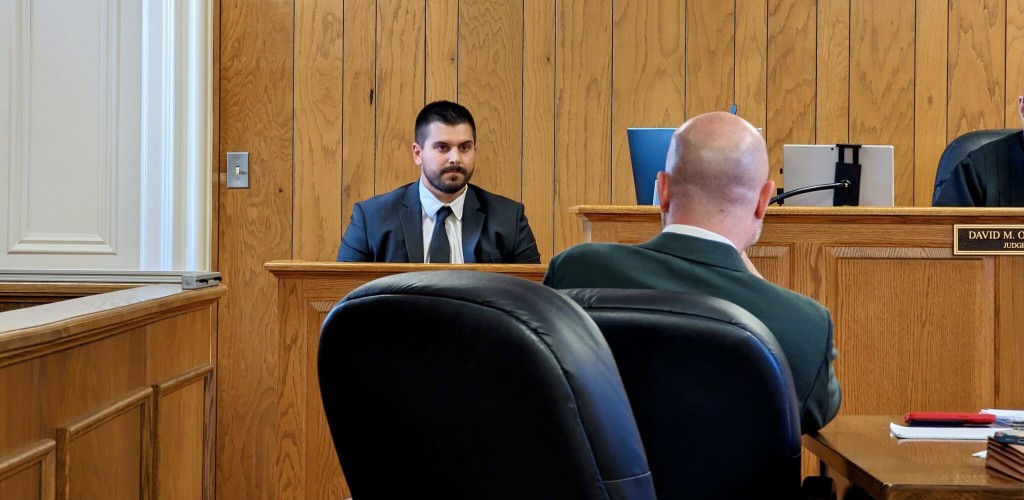
Lawyers for former Chester Township police officer Nick Iacampo filed a motion June 21 asking for a record of his interview with Lake County Sheriff’s Office detectives to be suppressed in a trial.
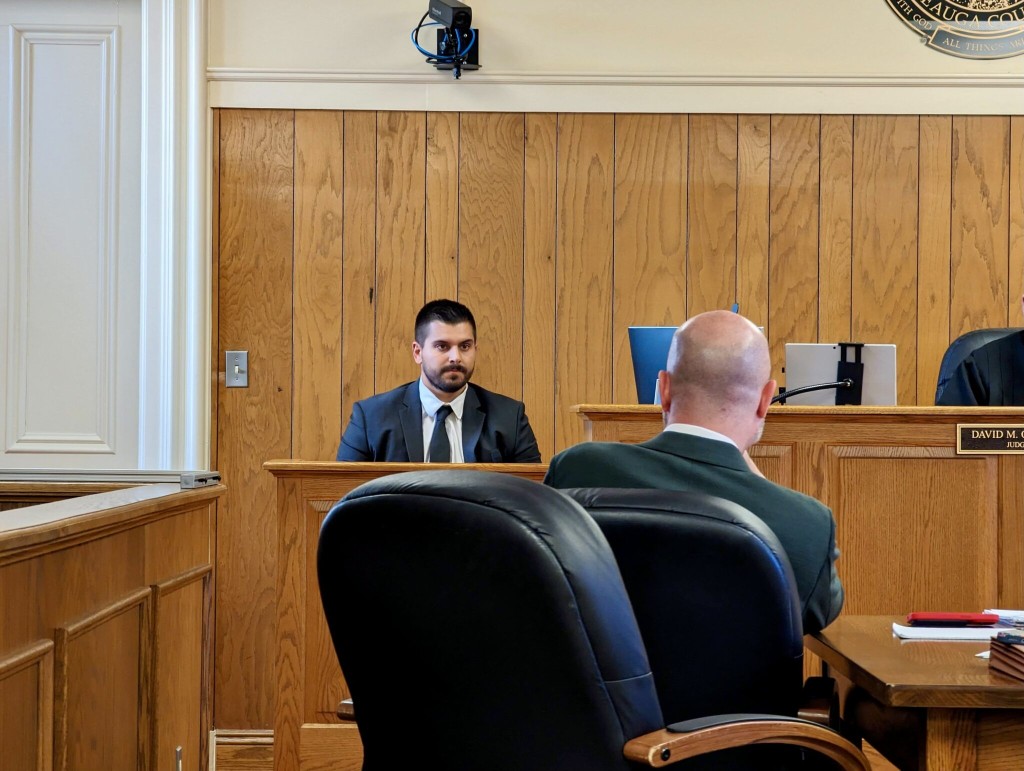
Lawyers for former Chester Township police officer Nick Iacampo filed a motion June 21 asking for a record of his interview with Lake County Sheriff’s Office detectives to be suppressed in a trial.
Across four previous hearings, Iacampo’s defense attorney, Ian Friedman, argued the Lake County Sheriff’s Office mishandled an interview with Iacampo — who also served as school resource officer at West Geauga High School from January to June 2023 — that took place around 3:45 a.m. Aug. 7, 2023.
Lake County Assistant Prosecutor Adam Downing maintained Iacampo was entitled to a Miranda warning — given in criminal cases — while Friedman told the court Iacampo was instead entitled to a warning under 1967 ruling by the U.S. Supreme Court in Garrity v. New Jersey, which determined employees of the state cannot be compelled to incriminate themselves under threat of termination.
“(Iacampo) was told that the interview was not voluntary and never told that he had the right to remain silent,” the June 21 filing said. “He was subjected to compulsion and never properly Mirandized or provided the proper Garrity warnings. As such, all his statements must be suppressed and excluded from the trial of this matter.”
Iacampo was charged with sexual battery after an incident last August when the parent of a 16-year-old WGHS student reported his daughter had been sexually involved with a Chester police officer.
In the interview, which was played before the court May 28, Iacampo said his sexual contact with the WGHS student was consensual, adding he “would never force anyone to do anything.”

In their June 21 filing, Friedman and co-counsel for defense Madelyn Grant said Iacampo admitted to engaging in consensual sexual conduct with the alleged victim and submitted his phone and a DNA sample to the detectives.
“It is alleged that Mr. Iacampo and (the alleged victim) eventually started kissing. Iacampo also purportedly touched (her) breasts and placed his hands inside (her) pants. If true, by all accounts, this was the first time that Iacampo and (the alleged victim) engaged in any sexual activity. Furthermore, both (she) and Iacampo allegedly maintained that all the conduct was entirely consensual,” their filing said.
However, all statements made by Iacampo during his interrogation were obtained in violation of his rights under the Fifth Amendment, which protects against self-incrimination, the filing said.
Even without considering whether Iacampo was entitled to rights under Garrity, Friedman and Grant argue the state cannot include statements or admissions Iacampo made during the interview because he was not properly Mirandized.
A trial has not yet been scheduled, as Friedman previously asked visiting Portage County Court of Common Pleas Judge John Enlow to consider two motions to dismiss the charges. One motion was based on an alleged violation of Iacampo’s rights under Garrity, while the other said Iacampo was not technically employed as SRO at WGHS in August, the time of the alleged offense.
A conference with attorneys was held June 24, but a representative of the Geauga County Court of Common Pleas confirmed June 25 Enlow has not yet made a decision on the charges. If they are not dropped, Iacampo will face a trial, likely later this year.
“The court is preparing to make rulings on pending motions,” Friedman said in an email June 25. “There will be additional filings from both the state and defense. If need be, we are prepared to proceed to trial.”
While prosecutors told Enlow Iacampo’s training as a police officer meant he was already familiar with Miranda rights, Freidman argued an admission by Lake County Sheriff’s Detective Dominic Hren that he did not explicitly tell Iacampo he had the right to remain silent meant the former SRO was not aware of that right on the night of the interview.
In their filing, Friedman and Grant laid out their case for excluding Iacampo’s late-night interview with Hren from the trial, if one takes place.
“(W)hile still working his scheduled shift, Iacampo received a call from (Chester Police) Chief (Craig) Young directing him to return to the CTPD station,” the filing said. “When he arrived at the station, Iacampo was ordered to speak with officers from the Lake County Sheriff’s Office. His firearm was confiscated and he was led to an interview room by his supervisor. Upon entering the room, Iacampo was immediately advised that his cooperation and submission to an interview was ‘no longer voluntary.’
“It is axiomatic that an individual cannot be said to knowingly and voluntarily waive a constitutional right that has not been identified and/or explained,” the filing continued. “Any claim that Mr. Iacampo should have known his rights merely because he was a police officer who had himself given Miranda warnings before is without merit. Mr. Iacampo had never been subjected to an interrogation as a suspect before.”