Russell Township Trustees held a special budget meeting March 16 following the announcement of a $4.8 million cash carryover for 2025.
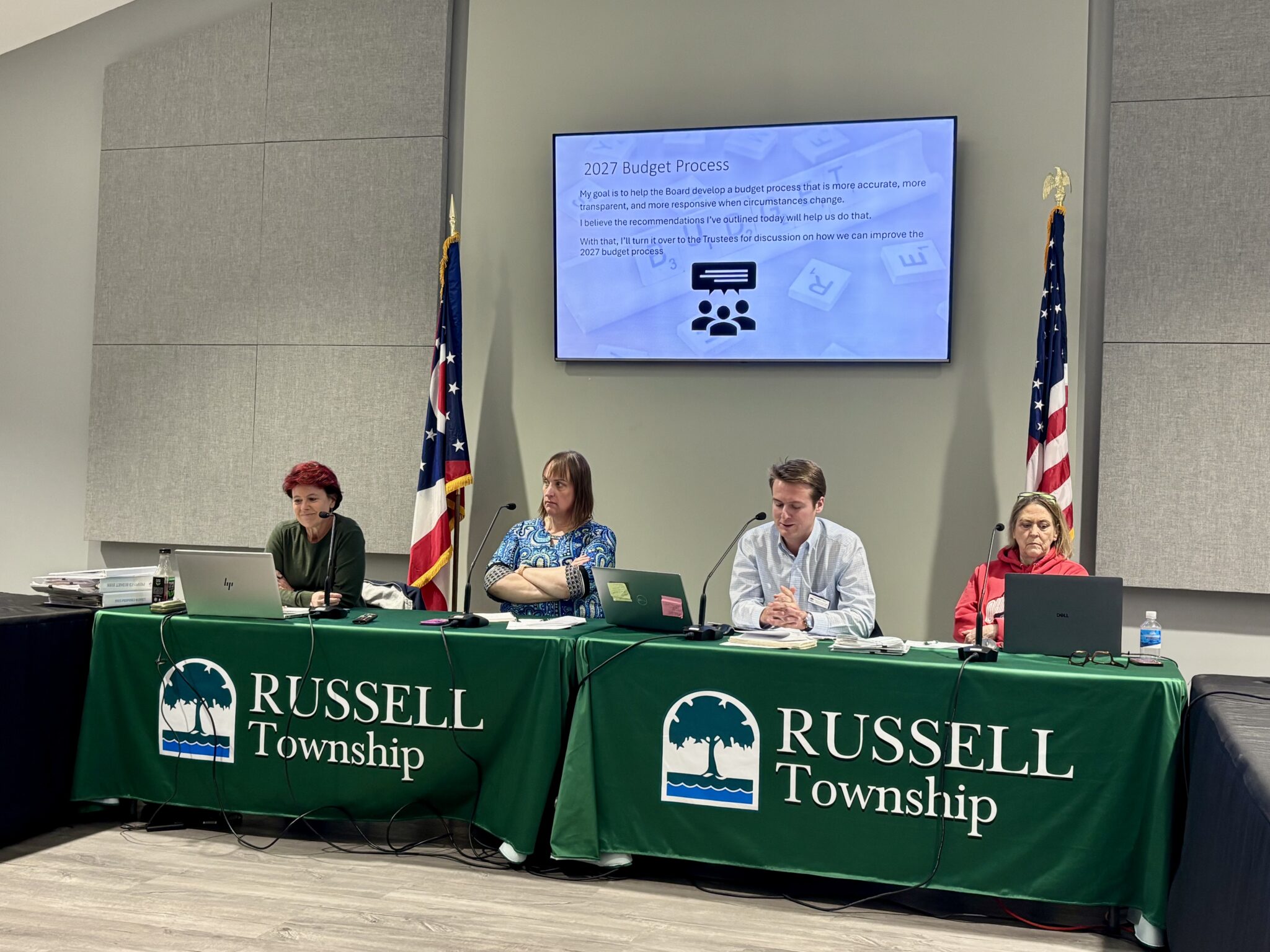
Russell Township Trustees held a special budget meeting March 16 following the announcement of a $4.8 million cash carryover for 2025.
“The difference between the budgeted carryover and the actual that was just in those four main funds, and … there’s three main things that account for that: one, our starting balance was higher than we anticipated, we got more revenue than we anticipated and we spent less than we budgeted,” Fiscal Officer Karen Walder said.
During the meeting, Walder presented an overview of the township’s current budget process and offered recommendations for improvement.
“We don’t have a revenue problem, we have a planning and execution problem,” Walder said. “We won’t get better at budgeting unless we accept that what we’re doing is not working. And I share the frustration and anger that our residents have, but … after numerous attempts to spur the board to address these issues, I’m really glad that there’s now an appetite to do that.”
She said the higher-than-expected carryover was due in part to the township receiving $142,000 more in revenue than budgeted for 2025.
She also pointed to several projects for which funds were appropriated but not encumbered, or spent, including $50,000 for road garage concept and preliminary plans, $45,000 for town hall maintenance repairs, $25,000 for a part-time community room event coordinator and $125,000 for additional road paving.
“So, when you combine these factors, the result is a significant carryover,” Walder told the board.
Trustee Amy Heutmaker noted department heads often rely on grants, which can also contribute to carryover.
“If we are able to save money and find a grant for something, great. Then, we can return that money as quickly as possible,” she said.
Among Walder’s recommendations was for officials to “adopt a different mindset.”

“In 2025, we reduced collection for one levy as part of our rebound relief and at the same time, we put out a new levy before voters. I think this is a confusing message for our residents,” Walder said.
She urged the board not to take on new initiatives without a clear plan to complete them.
“If the board decides not to undertake a project, unless the funds are allocated to a different project, it becomes carryover,” Walder said.
She also recommended trustees conduct budget workshops earlier in the year.
“(This allows for) sufficient time for the board to consider the department expenditures and, if needed, to consider the use of inside millage to supplement revenue of other departments, thereby avoiding a levy,” she said.
Trustee Chris Hare agreed, noting earlier review of the budget could help them identify discrepancies in department balances.
“Hopefully, a change that we can make is (to) evaluate our mid-year expenses, to (look at) the reality of how each of our departments are spending (and compare it) with what we project … getting a better idea of what our beginning balances are,” he said. “Hopefully that can, I would say, improve the facts and figures that we’re making decisions on.”
Walder also suggested trustees revisit the township’s Health Reimbursement Arrangement encumbrance, noting changes such as marriage or the addition of a child can affect costs.
Officials verbally agreed to return excess funds to taxpayers.
Hare suggested one option is reducing levy collections.
“What we can do is we can say, ‘Okay, there’s a road levy that’s going to collect $300,000 next year. We don’t need to collect on that.’ And we can transfer that carryover from the general fund to the road department, so we can decrease collection by $300,000,” he said.
One resident asked whether the excess carryover could be used for township needs, such as repairs to the aging town hall building.
“I have some reservations on going on the spending side,” Hare said. “Firstly, just because I think some of the demographics of Russell being that we’re one of the more, I would say, senior populations within the town. I mean it very seriously that when you view retirees on a fixed income that I would prefer not to have tax rates rise too high, if we can provide some relief. That’s priority number one.”

Walder emphasized it is ultimately the trustees’ responsibility to make those decisions.
“We elect our trustees to make those evaluations and make those tough decisions. Do we invest in pickleball courts or do we give money back to the residents?” she said.
Residents also raised concerns the township was not planning far enough ahead.
“I would like to clarify the statutory budget that we are required to produce requires two years prior, current year and one year ensuing,” Walder replied. “Our practice has been to do a five-year forecast and the mechanism allowed by law to save for these projects is a reserve fund. So, our reserve study specifies particular elements in each of our buildings and looks out 40 years on what we should be saving and when each of these replacements need to be done.”
Trustee Kristina Port noted township officials consider long-term maintenance needs for buildings.
Toward the end of the meeting, officials expressed a commitment to improving the budgeting process.
“My goal is to help the board develop a budget process that is more accurate, more transparent and more responsive when circumstances change,” Walder said. “I believe the recommendations I’ve outlined today will help us do that.”
Hare verbally pledged to do better, work better and make sure such a large carryover does not happen again in the future.
“The privilege of getting caught with these changes is also the privilege of being able to hopefully improve our budgeting process going forward,” he said.
Heutmaker added, “We have this overage right now, we’re listening to you guys and we’re going to find a way to do what’s best for you. We’re not just going to sit here and do nothing with it. We’re going to get back to you what we can and do what’s best and deliver the best services we can with the taxes you entrust us with.”