


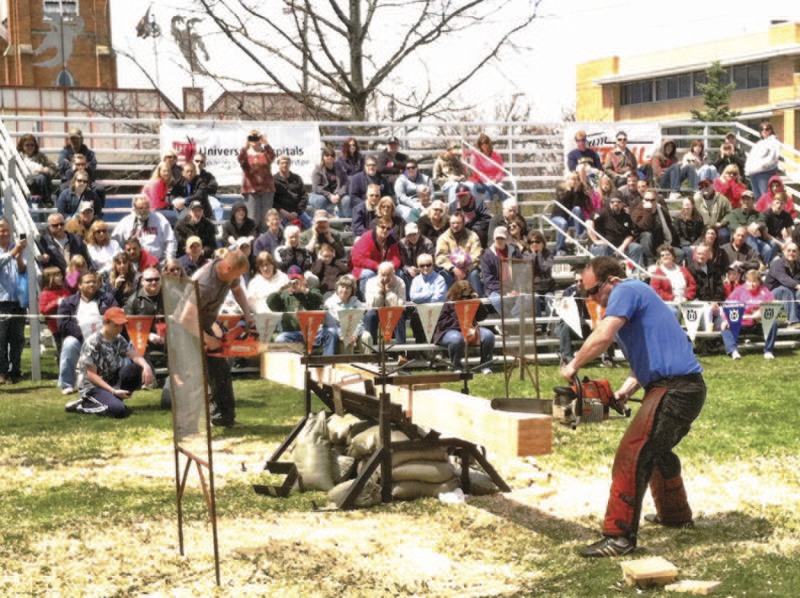
The buzz of chainsaws met the buzz of festival-goers as Mother Nature delivered sunny skies to the closing day of the annual Geauga County Maple…
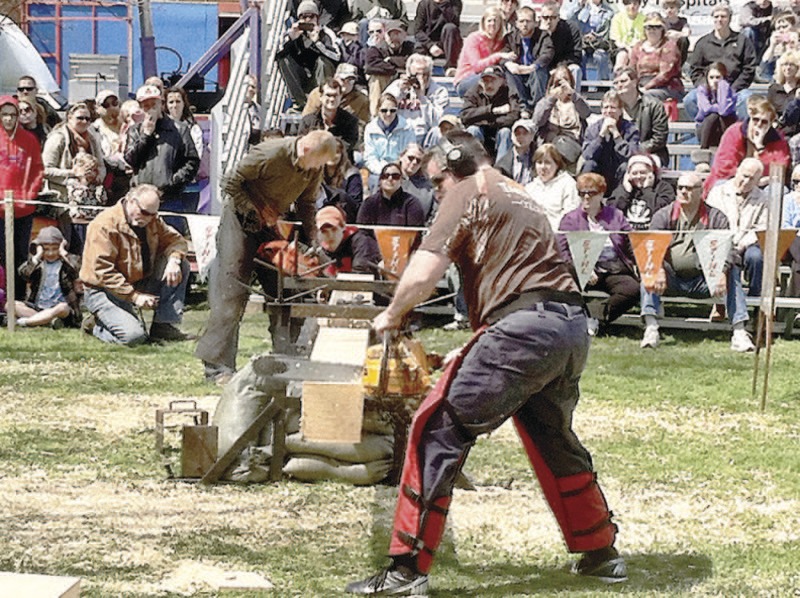
The buzz of chainsaws met the buzz of festival-goers as Mother Nature delivered sunny skies to the closing day of the annual Geauga County Maple Festival.
“Good afternoon,” Emcee Jim Freeman said, as audience members scattered to take bleacher seats at the north end of Chardon Square.
“We are going to put on a Lumberjacks competition today. If you see something you like, let them know,”?he said.
Lumberjack athletes hailing from Ohio, Pennsylvania, Michigan, Virginia, West Virginia and New Hampshire convened for one of the oldest festival events with the sport growing nationally in popularity.
“It’s something unique,” said Jen Freeman, Geauga County Maple Festival president.
Rail splitting first took place at the 1927 Geauga County Maple Festival.
“You can’t see it at every fair and festival,” she said. “There are only a few held in Ohio. Some of the guys competing are on the Stihl Timbersports series. They are world-wide champions.”
The preliminary contests kicked off with all entrants competing on Saturday and the top six finalists in each event advancing on to the finals on Sunday.
“We try to have about the same number of contestants each year,” Jen said. “It is by invitation only — we have time and space constraints, so we keep it the same size.”
White pine timber is donated from Middlefield’s Trumbull County Hardwood.
“These timbers were still in the form of logs on Friday morning,” Jim Freeman said. “They were brought up Friday evening.”
This year’s event featured six chain-saw contests — different sizes and one just for women, axe throwing, chopping and two different cross cut saw events — over the two days with at least $4,800 in total prize money.
The first-place winners in each category were awarded Geauga County Maple syrup made at the Geauga County Maple Festival Sugarhouse.
Lumberjack sports in all countries have evolved from the occupation of wood chopping based on rich forestry history. Lumberjacks were known in the 19th century as “the toughest men in history” for a grueling and dangerous profession when men felled trees for a living.
This year’s events included: Axe Throwing the oldest event, 0-50 stock class hot saw, 0-81 Muffler modified, only restrictions is there is one carburetor and one cylinder; Bow Saw hand saw, X-Cut 5.5- to 6-feet long, back and forth, 0-81 Pipe hot saw; Jack-n-Jill two person cross cut; Powder Puff a woman running a stock saw, 0-140 Muffler bigger class, larger cylinder; Chop underhand chopping; and Open chainsaws may be of any manufacture including snowmobile and motorcycle.
Events using hot saws involve a single sawyer using a single-cylinder, single-motor power saw making three vertical cuts — down, up and down — through a 20-inch-diameter white pine log.
The one-man event is strictly against time. Chain saws may be warmed up prior to the contest, but must be turned off before the contest begins. After the signal “go,” competitors start their saws and make three cuts. The contest ends when the third-slice is severed.
The primary challenge with the hot saw is the reliability of the custom saw.
The world record time was set in 2003 by Matt Bush in the hot saw at 5.085 seconds.
Pick-ups filled the eastside of the courthouse as competitors assembled make-shift pit stops and setup areas for their equipment.
The scent of freshly cut wood mixed with the sweet aroma of funnel cakes and grilled meats from a plethora of concession stands.
Jen said she quickly fell into the sport when about 14 years ago, she began dating her husband, Ken Freeman.
“It is a family affair,” Jen said.
David Freeman, 14, stood nearby with a timer, just off a win with his sister, Heather, in the Jack and Jill competition. It was the first time he won prize money for his sport.
The Cardinal Middle School student tore open an envelope with $10 in it taking fifth place in the event.
“I am going to buy my friend a ride wrist-band with this,” David said.
Heather added, “I’m out of breath. My arms feel like Jell-O. You have to have upper body strength.”
Nate Blakeslee, of Spartansburg, Pa., brushed off some woodchips from his T-shirt and hoisted up one of his hot saws resting near his truck, placing it on a folding table and draining the alcohol and nitro-methane mixture fuel.
Blakeslee is one of the few competitors of the Chardon event who work with chain-saws for a living in the timber business in logging and lumber, but he said not the same saws are used in competition.
Jen explained how all the saws used are heavily modified and sent to shops around the United States and Canada.
“It’s not a cheap sport,” Jim said, adding a hot saw modifications costing up to $7,000 and $60 a gallon for the gas.
“The fuel is so aggressive, it eats the rubber gaskets in the carburetor,” he said. “You need to flush out the gas to save the carburetor.”
A friendly rival, Jody Hutton, of New Castle, Va., looked on and chatted with Blakeslee, comparing their sport to drag racing.
“You can have the fastest one here, but you have to be the one to make it all happen,” Hutton said, with a smile, his third time competing at the festival.
“The saws get wicked fast,” he said. “In Virginia, this is almost like someone golfing. It takes athleticism, motor timing and skills.”
As the revving of chainsaws halted, applause and whistles filled the bleachers.
“Raise your hand if you want earplugs,” Jim announced to the crowd, just before the start of another round. “Timers ready? Contestants ready?… 3-2-1, Go.”
“It’s exciting,” Blakeslee said, having a “good day” competing alongside veteran world champion Jerry Gingras of Errol, N.H.
“It’s a rush,” he said. “I really like running saws.”


