
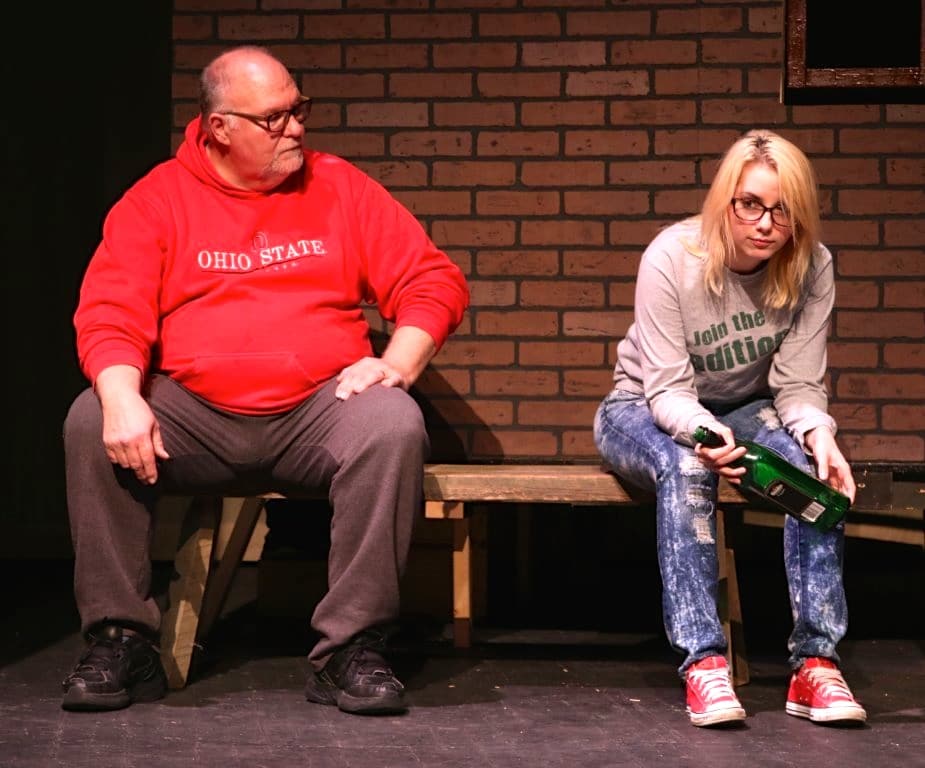
David Auburn's 2001 Pulitzer Prize-winning “Proof,” currently on the Lake Erie College stage in collaboration with Rabbit Run Theater, is a dramatic exploration of the fine line between genius and mental illness.
By Eric Kish
David Auburn’s 2001 Pulitzer Prize-winning “Proof,” currently on the Lake Erie College stage in collaboration with Rabbit Run Theater, is a dramatic exploration of the fine line between genius and mental illness.
The play revolves around Catherine, the younger daughter of recently deceased Robert, a brilliant mathematics professor who did groundbreaking work but was plagued by mental illness late in life. Catherine, we learn, gave up her own college studies to care for him, all the while wondering whether she had inherited her father’s high-functioning but frail brain.
After Robert dies, Catherine’s successful and overbearing sister Claire tries to convince her to go back with her and her fiancé to New York while Hal, an endearing and engaging former student of Robert’s, is digging through her father’s notebooks in search of a forgotten breakthrough in mathematical proofs.
The playwright cleverly employs the very method used in devising proofs to tell this story, starting with undefined elements, working through their potential relationships, and allowing their worthiness and true nature to surface in the end. He also populates this play with complex characters who are not always fully realized in this production under Jerry C. Jaffe’s direction.
Greg Gnau, as Robert, brings a brilliant mix of reservation and bombastic emotion to his few scenes, stirring the audience’s sympathy and sorrow.
Elizabeth Allard nicely captures Claire’s incredible dominance and pretense while also communicating the love and concern she has for her struggling sister.
As Hal, Lance Gentile is mostly effective, but he is difficult to relate to as a result of his limited emotional range which makes short work of the more dynamic moments in the play he is handed.
Meanwhile, Jessie Moore effectively hits Catherine’s emotional highs and lows – her cold malaise and her frustrated outbursts –but never seems quite comfortable with the area in between where her relationship with her father resides. The character on stage does not have the same depth as the one on the page.
Designers Martin Bluestein, Ray Beach and Julie Harter do a marvelous job creating the realistic world in which this play exists. The back porch of Robert’s Chicago home, where the action takes place, is simply incredible. Fully functioning rooms can be seen through the windows, which creates the impression of a well-lived in abode, and the fence posts and loose brinks that reside to the right of the porch raise questions that the play will eventually answer.
It’s been said that a good mathematical proof should be elegant as well as an effective means to an end. The same holds true for David Auburn’s play, “Proof.” While this production is most certainly effective, some acting choices take away from the elegance.
This review is supported by a Cleveland State University civic engagement grant.
WHAT: “Proof”
WHERE: C.K. Rickel Theatre, 391 West Washington St., Painesville
WHEN: Through April 9
TICKETS & INFO: $13-15, call 440-428-7092 or rabbitrunonline.org.