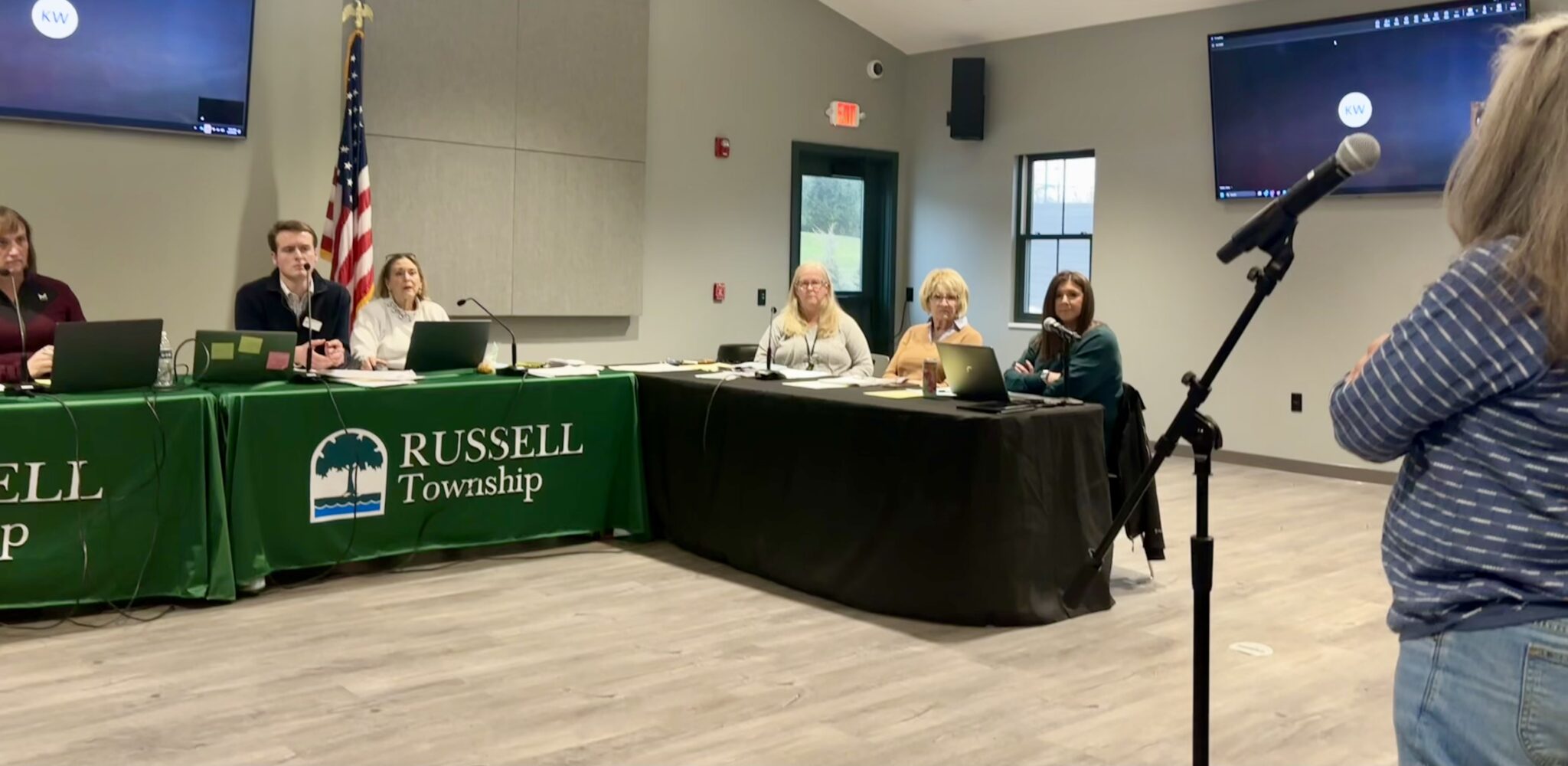
Eleven residents attended the Russell Township Trustees meeting March 5 to express concerns about the township’s $4.8 million cash carryover, which Fiscal Officer Karen Walder announced at the Feb. 19 regular meeting.
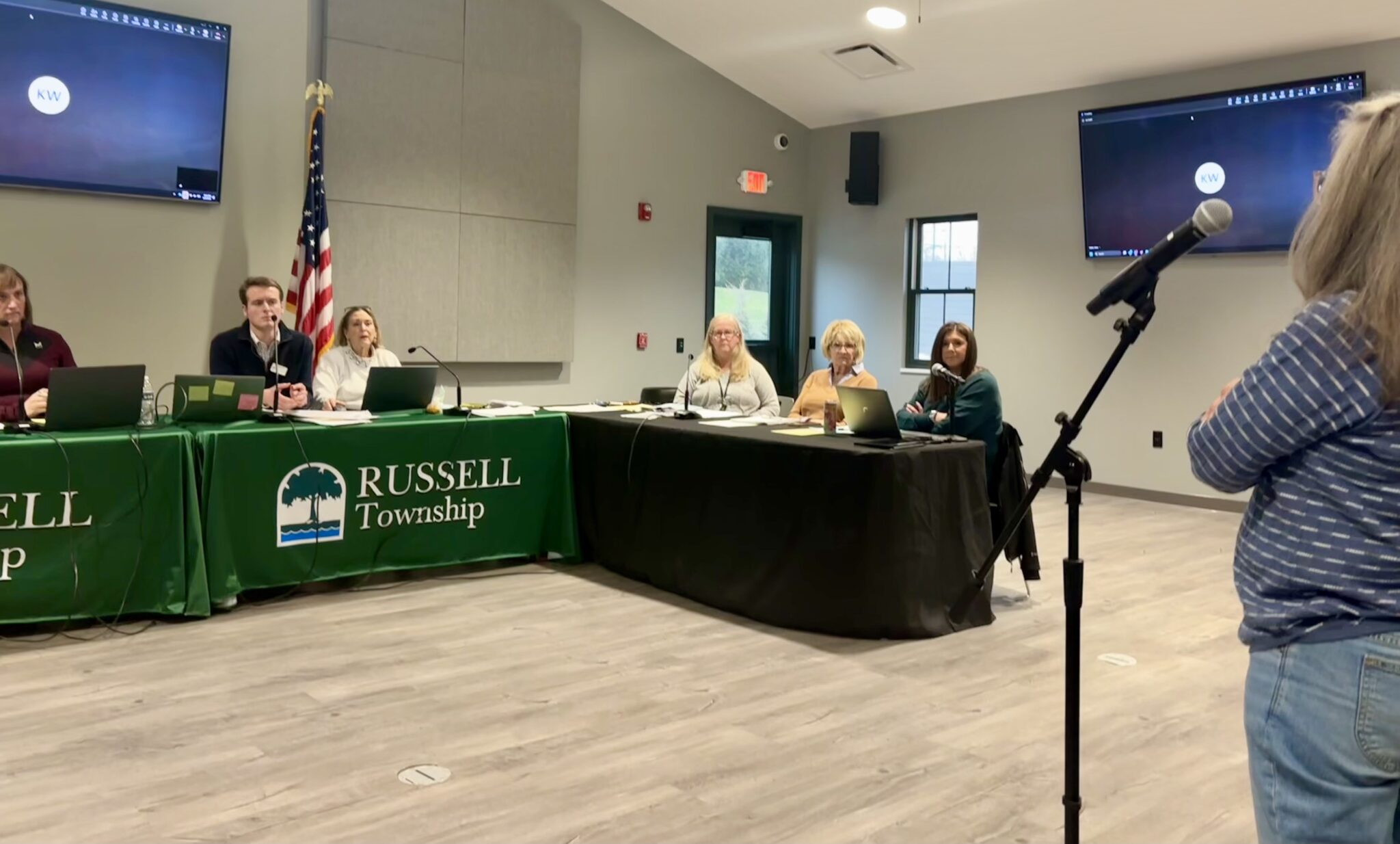
Eleven residents attended the Russell Township Trustees meeting March 5 to express concerns about the township’s $4.8 million cash carryover, which Fiscal Officer Karen Walder announced at the Feb. 19 regular meeting.
“At the (Feb. 19) meeting, I had reviewed actually an email that I had sent to the board (stating) the actual cash balances at year end far exceeded the projected balance from the township’s 2025 budget,” Walder said in a March 6 phone interview. “In just the four main funds, the projected cash balance was $1.7 million and the actual was $4.8 million.”
Resident Concerns Over Police Levy
Resident Tonda Poppe told trustees during the March 5 meeting she was concerned the police levy approved last fall may not have been necessary given the carryover.
“I want to be very clear to say thank you to all our officers and my research doesn’t in any way indicate lack of support. I’m very grateful,” Poppe explained. “I definitely support levies when needed. But, when doing the research, it looks like given the excessive amount of levies that we have — and my understanding is that the average carryover is 20 to 40% of a total budget — each department far exceeds that.”
Trustee Chris Hare said the county standard is a 30% carryover, while Russell Township aims for 25%.
“The $3.4 million that we’re looking at does not include the levy money, which we have yet to see,” Poppe said. “So, this is before the levy money even comes to us. So, why that amount of excessive carryover? And why did we ask for a levy, knowing we may have had funds to cover that?”
The levy, which passed by 40 votes last November, will yield $999,145 annually and cost homeowners $88 per year per $100,000 property valuation, according to the Geauga County Auditor’s Office.
Hare said the budget projections and actual spending do not always align.
“In this case, (when) we’re talking about the levy, you look at, say, benefits and you’re given an ‘X’ number, and when going into the new year, we have to budget for anticipating spending that,” he said. “Well, we know that we’re only spending 57%, 60% of that amount. It doesn’t entirely match up with what would be the entire cost of every dollar spent (or meet) the recommended carryover into the new year.”
Nevertheless, the board does not consider the discrepancy acceptable, Hare said.
“By no means do I justify (the carryover) as an acceptable error,” he said. “This is a problem that has to be addressed. None of us want to be collecting money for the sake of money. That’s just absolutely important and we’re looking to correct that going forward.”
Poppe also noted two emails Walder sent to trustees expressing concern about placing the police levy on the fall ballot.
The first email, dated July 14, was sent from Walder to trustees Kristina Port, Chris Hare former Trustee Jim Mueller, as well as Board Administrator Melissa Palmer.
“I do not in any way intend this communication to call into question the fine work Chief Swaidner and our police officers do for our residents,” Walder wrote in the email. “The work of our police department is work of which we can all be justifiably proud. My concerns arise from the optics of placing a levy of this size before the voters at a time when local, state and national news is focused on property tax relief, reducing the size of government and the existential threat presented by a constitutional amendment to eliminate all property taxes in Ohio. I think we have all followed with interest the news of the property tax relief initiatives in the state’s budget, only to have the governor veto many of them. I share with our residents their frustration over the lack of meaningful property tax reform.”

In the email, she suggested the board “think like a taxpayer,” Walder said.
“My unease stems from the fact that since this board directed me to determine the additional revenue needed over the next five years to fund a full-time detective, reserve transfers per the study recommendations and 3% raises starting in 2027, which resulted in the $2.5 (million) estimate, this board has not asked me to run a single scenario to explore these ‘what ifs,’” the email read.
There was no response from trustees, though Port did verbally acknowledge receiving the email, Walder said.
In another email, dated Sept. 12, 2025, Walder wrote to Port, Hare, Mueller and Palmer suggesting resources be made available to residents regarding the levy.
“I would like to offer some suggestions that I believe would increase transparency and access to the relevant documents, while maintaining compliance with (House Bill) 140 requirements that township communications be factual, neutral and verifiable,” Walder wrote.
She added she had heard numerous questions from residents about the levy’s details and need and suggested creating a page on the township website linking to resources such as Geauga Realink, the Geauga County Board of Elections and the League of Women Voters of Geauga website.
“My only thing is, as trustees, we cannot weigh in on levies,” Port told Poppe during the meeting, referring to her hesitancy to respond to Walder’s email, as trustees are prohibited by the state from sharing opinions on levies.
“We’re talking about publicizing information in the public domain,” Poppe replied. “(These are) not secret links here. We are not inventing links. We’re simply making those links available to the public so they can be informed with all the information that’s available for them to make decisions.”
Port asked Poppe to forward the emails to her.
“In case I have to review that to see if I made an omission,” Port said. “I don’t know if all the information was passed onto trustees because we have a board administrator who gets all of our information.”
Resident John Lafler also asked trustees to address at their next meeting whether the carryover will affect existing township levies.
“And whether or not we have too much funds, whether or not (the police) levy should be retracted somehow,” he said.
Hare said those questions would be addressed.
Officials Work to Decrease Costs
Walder said the township’s budgeting process needs improvement.
“I would just like our residents to know that I think that it’s glaringly apparent that the … budget processes in Russell are not working in our taxpayers’ best interests and I urge the board to do the right thing for our taxpayers,” she said at the meeting. “We need to own it, return it, correct it … I can do (an analysis) on how we got there once I get back to the office, but I can’t make up for the lack of understanding our actions by the board at that time.”
Hare assured residents that department heads are already working to reduce costs.
“The one thing I want to see is, if you’re bringing something in, tasers or something that you want to purchase, I want to see that it’s done competitively,” Hare told Police Chief Tom Swaidner early in the meeting.
Swaidner brought a binder with four or five bids for one item, Hare said.
Hare added the fire and road departments have also worked to save money whenever possible.
Road Superintendent Giovanni Maltese recently identified the township’s need for an MS4 BioSwale project and retained engineering consultant Verdantas, of Mentor, to evaluate other options.
“(MS4) BioSwale is not the only option that township has. There’s four or five options in order to satisfy the Ohio (Environmental Protection Agency) violation,” said Pete Formica, of Verdantas, at the meeting. “One of (the choices) being just changing your resolution or your regulations to say that anyone that develops in the township has to abide by a certain table for their stormwater best practices.”
The MS4 BioSwale project would have cost the township $140,000, Hare added.
“I’ll give them the credit that they are very competitive with their budgets,” he said. “Again, it falls on us to make sure with the general fund that we’re spending that wisely. I would like to acknowledge that it’s not necessarily that we’re looking to have such a high carryover, but sometimes, unfortunately, the budget does not go as we forecast. I would say sometimes better reasons than for worse. I understand it’s obviously not a sufficient answer to the size of this carryover, but the best thing we could do going forward is to right this, of course.”

Future Budget Processes
Trustee Amy Heutmaker assured Walder and residents she is committed to improving the township’s budgeting process.
“We are committed to correcting this. We are going to look at the process, we are all on Team Russell and working together for that common goal, and we are going to find a way to correct and move forward (to) do budgets differently,” Heutmaker said.
Officials agreed to hold a special “budget kickoff” meeting to review the issue and plan future budgeting procedures.
“I proposed that the board needs to understand what contributed to that and how to do better in order to ensure that we’re not over-taxing our residents,” Walder said in a March 6 call. “I suggested that we approach the budget process for 2027 differently and have a kickoff meeting so that the elected officials can work together on the plan to hopefully approach the budget differently so that these kinds of excess carryovers would not happen in the future.”
The special meeting will take place at 5 p.m. March 16 at the Community Room, 8501 Kinsman Road in Russell Township.