


Governor’s Proposed Budget Puts Educational Funding Weight on Taxpayers
With school boards across Ohio concerned about a proposed state budget that would reduce public school funding, multiple architects of Ohio’s Fair School Funding Plan came together March 12 for a discussion on the topic
With school boards across Ohio concerned about a proposed state budget that would reduce public school funding, multiple architects of Ohio’s Fair School Funding Plan came together March 12 for a discussion on the topic
The ongoing situation traces back to the DeRolph Decisions, an Ohio Supreme Court case from the 1990s that declared Ohio’s school funding system at the time unconstitutional, former Ohio Rep. John Patterson explained during the talk, which was hosted by the League of Women Voters of Ohio.
Multiple funding formulas followed, culminating in the FSFP, which Ohio currently operates under. The plan addresses the question, “What does it cost to educate a student?” he said, something DeRolph hadn’t included.
Per DeRolph and under Ohio’s constitution, there is a shared responsibility between the state and local district to bear the cost of educating a student, Patterson said.
Districts with greater wealth contribute more, while the state contributes more for less wealthy districts.
Up until the FSFP’s introduction in 2021, there was not a funding formula that worked for the majority of districts in Ohio, Chardon Schools Superintendent Mike Hanlon said, adding under the current plan, there has been a $1.5 billion increase in state funding since fiscal year 2022.
The FSFP is currently in year four of a six-year phase in, Shared Services Alliance Executive Director Ryan Pendleton explained.
Under House Bill 96, Gov. Mike Dewine’s proposed biennial budget, traditional school districts received a decrease in funding, while community and STEM schools saw an increase, as did joint vocational schools, he said.
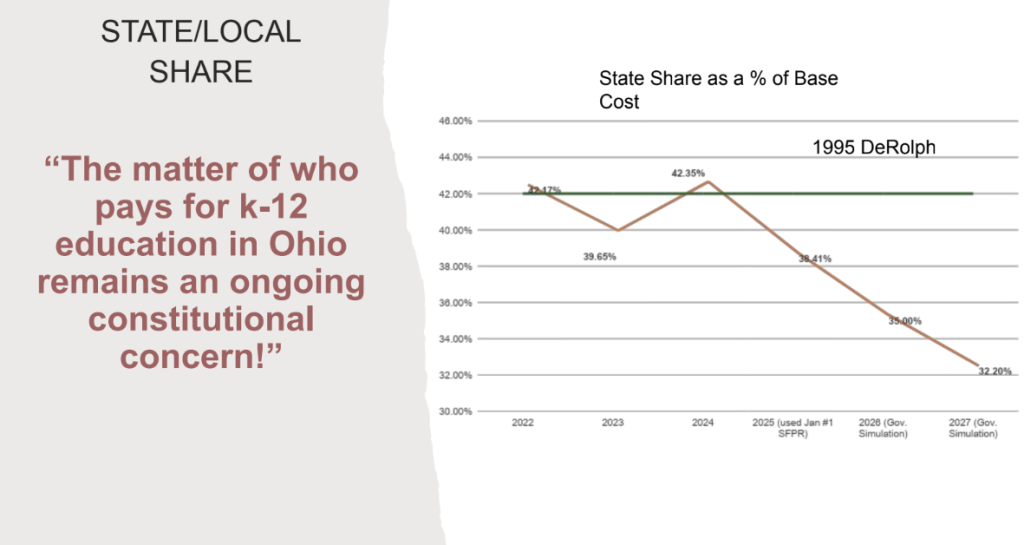
“The matter of who pays for K-12 education in Ohio remains an ongoing constitutional concern,” Pendleton said.

During the DeRolph case, the state’s share of the base cost to educate a student was around 42%, he said, adding at the current moment, the state share is around 38%. Under the proposed budget, it would fall to 32%.
Per the governor’s budget, 80% of Ohio’s school districts get wealthier “on paper” in fiscal years 2026 and 2027, and over half see a decrease in state funding, Pendleton said.
The changes are not from any actual increase of wealth in the districts, he said.
“The state’s side of the components for the state and local share formula are updated, but the local side is not,” he said.
Public finance expert Howard Fleeter, who has been working on school funding in Ohio since 1990, said updating the base costs has only been a controversial item in recent years. Previously, it was understood the formula needs to be based on current data.
“I think a large part of that is the state not wanting to absorb the cost of continuing to keep that side of the formula updated,” he said.
The projected decrease in the state’s share of funding is a direct result of not updating all of the data, he emphasized.
“You’re keeping the pie the same size and redividing it in favor of the state share going down and the local share going up,” he said.
From FY 2025 to 2027, there is a projected decrease of $103.4 million for traditional districts, he said. Meanwhile, voucher schools would see an increase of $265.4 million.
Vouchers represent allocation of public funds from the state to pay for the costs of students at non-public schools in order to promote choice, with voucher amounts varying depending on a family’s income, Hanlon explained in a Feb. 24 email.
“There has been a massive change in vouchers over the last several years. The amount of funding has gone up dramatically, and just from the FY23-FY24 school year … funding for vouchers went from $610 million in FY23 to $962 million in FY24,” Fleeter said.
Eighty percent of the increase was from one voucher program having an income requirement removed, he said.
“We had a $350 million increase in just one year in payments to families who are already sending their kids to private schools,” Fleeter said.
Meanwhile, public schools will lose money under the proposed budget, he said.
A failure to maintain inputs puts the state back on a non-functional formula, Pendleton said.

To not update them puts a larger burden on taxpayers, while updating them is a form of tax relief, he said.
Legislators need to hear from community members, staff and parents about school funding, Hanlon said, adding this can be done through letters to legislators or through testimony at the state house.
The key message is that, in order to fulfil the legislature’s constitutional obligations, the input components must be updated and the plan fully phased in, he said.
In a testimony before the House Education Committee Feb. 25, Hanlon acknowledged there is less state money available and stressed the need to work together to protect local communities. Without decisive action on the budget, there is the risk of undoing progress and widening educational inequities, he said.
Cardinal Schools in Middlefield are one example of said inequity.
Treasurer Terry Armstrong presented an overview of the district’s funding, according to the FSFP, if it is not updated.
“Total state funding per student received by Cardinal Schools is only $3,828.37, compared to a state-wide average of the 20 most similar districts of $8,825.38,” he said.
At this point, it is projected the state share, which was 42.35% in 2024, will decrease to 38.41% this year and drop to 35% in 2026.
While the district has a high property valuation, that valuation does not increase the amount of local tax money coming in because the levies’ yields are fixed amounts, he explained.
Armstrong urged all residents to contact their state senator and representatives and ask them to update the plan.


