


Where are Mulberry Road’s mulberry trees? Is there an actual Chesterland? And what is the connection between Chester Township and the City of Hudson?
Where are Mulberry Road’s mulberry trees? Is there an actual Chesterland? And what is the connection between Chester Township and the City of Hudson?
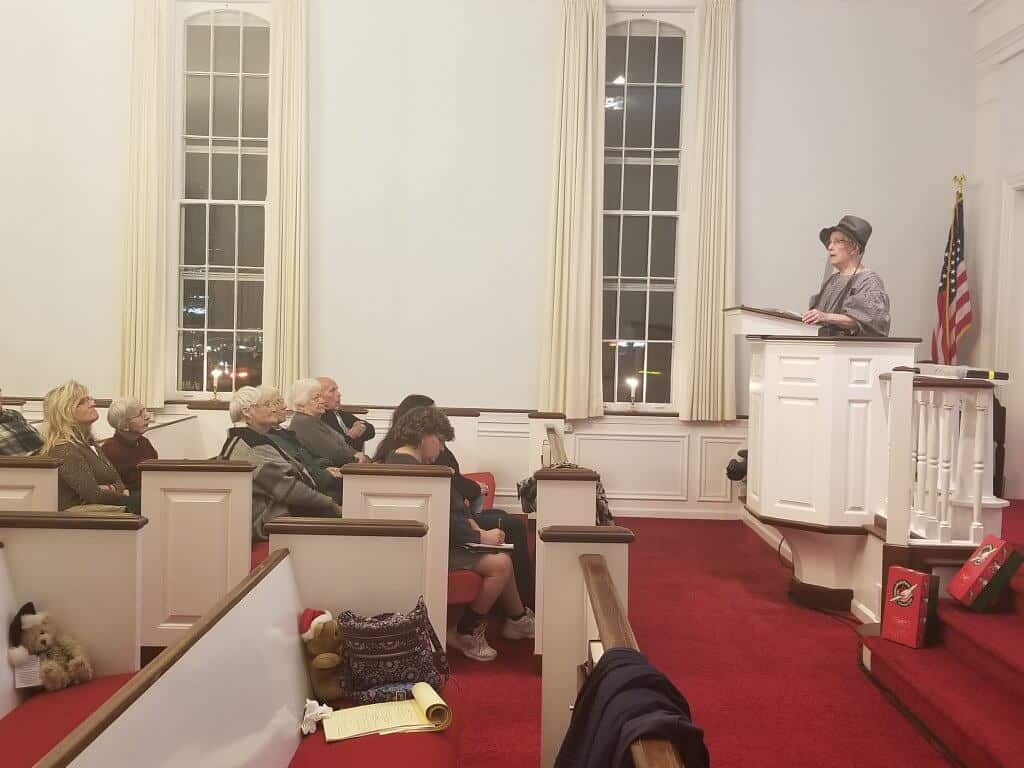
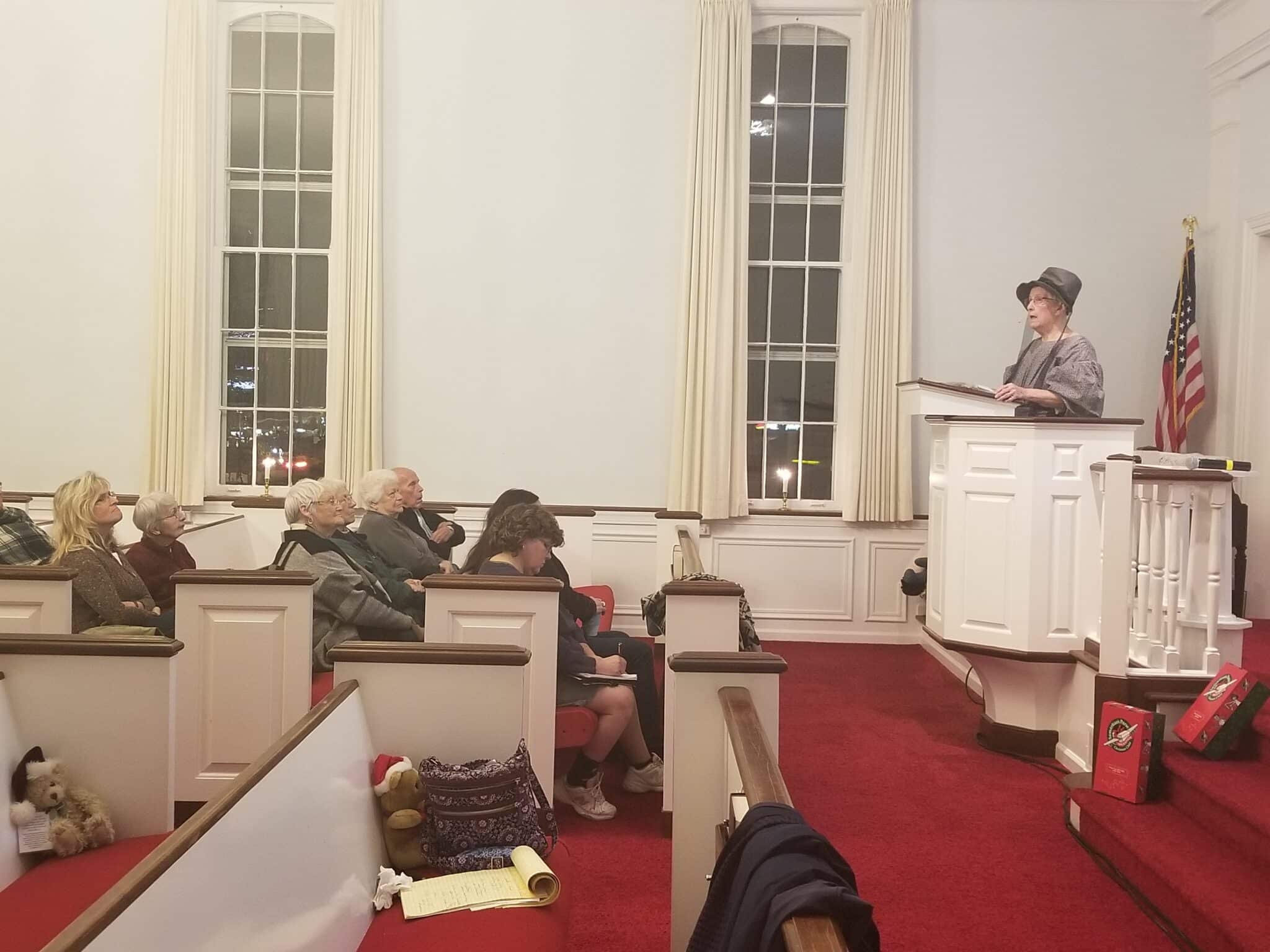
Those questions, and many more, fueled a program on local history Nov. 10 at Chesterland Baptist Church to kick off its 200th birthday next year.
Lifelong church member Garland Likins gave a brief history of the historic white-framed church, followed by a talk from historian Sylvia Wiggins, of the Chester Township Historical Society, dressed in period costume.
During the earliest days of the Connecticut Western Reserve, when the State of Ohio was only two years old, missionary Thomas Robbins walked from New England to the forested wilderness of the new territory to minister to the earliest settlers of the area. It was a time called “The Great Awakening,” when churches began to flourish across America.
By 1819, seven pioneers of what is now called Chester Township met to form a Baptist congregation called the Baptist Church in Christ in Chester. They included Nancy and James Gillmore, and Lebbeus and Nancy Norton, who had arrived in the Western Reserve in 1812 from Massachusetts.
That small congregation flourished as the area grew and is now the Chesterland Baptist Church, 12670 Chillicothe Road, just north of Mayfield Road. The current building dates back to 1870, Likins said.
Wiggins told the audience of about 60 people the first settler of the township was Justice Miner (1762-1850), a Revolutionary War veteran who walked to the area in 1801 and built a cabin near what is now the south side of Mayfield Road between Heath and Sperry roads.
“He cleared the land, built a cabin and then walked back to New York to get his family,” Wiggins said. “In 1802, they got here. They decided to call the area Wooster, after a Revolutionary War general.”

As other families arrived in the township, it soon became clear that “Wooster” already existed in Ohio, so because the Gillmore family hailed from Chester, Mass., “Chester” became the community’s new name.
“But eventually they found that their mail was being sent to Chester Township in Meigs County, so they decided to use the name ‘Chesterland’ for their post office purposes,” Wiggins explained.
The “Old Settlement” of Chester Township was on what is now Mayfield Road near Heath, Sperry and Kenyon roads. A small old cemetery can still be seen from the road, although the original houses are long gone.
In those early days, the township was teeming with wildlife, particularly bears and snakes, Wiggins said.
When Ohio became a state, the new government paid local men to build a road from Painesville on Lake Erie south to the state capital at Chillicothe, which Wiggins said is a Shawnee word meaning “place where many people gather.”
Recounting the sights a stagecoach passenger would have seen riding along Chillicothe Road in the early 19th century, Wiggins described how Steven and Sally Bassett settled in the north end of the township in about 1815.
“He had a big idea that he could make his fortune manufacturing sewing silk, so he planted mulberry trees and brought in silk worms,” Wiggins said. “Over time, his wife and daughters made a lot of sewing silk, but they found it was too much work, so he cut all the mulberry trees and got rid of the worms. But although they are long gone, we still have Mulberry Road.”
Other pioneering families in the township included names like Gilbert, Whitman, Lyman, Covert, Lamoreaux, Knapp, Hewitt, Norton, Philbrick, Stephenson and Hudson.
David Hudson, founder of the city in Summit County that still bears his name, was a prominent landowner in Chester Township in 1811, Wiggins said.
He owned much of what is now the township’s main intersection of Mayfield and Chillicothe roads.
“He donated land at the northeast corner to the township for a park that would remain a park ‘forever and ever,’” Wiggins said. “Why, I don’t know. But we still have it today.”
The park was the scene of many major celebrations in the community over the years, including one celebrating the Armistice ending World War I. Wiggins said the township burned effigies of the Germans Kaiser Wilhelm and military leader Von Hindenburg at the park as part of the celebration.
The Hudson family included 14 children, including David’s son, William, who owned land that is now Guido’s commercial complex. He was paid $10 from Geauga County to work on the construction of Chillicothe Road in front of his farm.
He moved to Meigs County, Ohio, in 1838 and was killed there by Morgan’s Raiders in 1863, Wiggins said.
The restaurant currently known as the Buck Stop was built on what had been William Hudson’s land in 1843 and served as a stagecoach stop, she said.
Also in 1843, the people of the community decided to build a school for higher learning — a forerunner of the public high school — on the north edge of town, near the current township recycling center. Called the Western Reserve Seminary, the three-story building, plus basement, housed boarding students. Probably the most famous student, James A. Garfield, became a student there, along with his cousin, in 1849.

“He was a laughingstock, in his patched pants and faded shirt, and he worked for his room and board,” Wiggins said. He was known for his frugality and his skills in speech, shorthand and debate.
Garfield joined the Disciples of Christ Church in the township and was baptized in the Chagrin River at a spot near Fairmount Road. Later, he was known as the country’s first and only president who was an ordained minister.
At the seminary, young Garfield met another student, Lucretia Rudolph, whose boyfriend had died. Rudolph became Garfield’s wife and, eventually, first lady of the United States.
“Garfield became the champion of abolition, Negro suffrage and women’s suffrage,” Wiggins said.
Although there appear to be no records of the Underground Railroad in the township during the Civil War, Wiggins guessed the area was strongly pro-abolition and fear of reprisals from the Fugitive Slave Act, which forbade people helping enslaved people escape, may be the reason there are no historical records about any activity.
The historian, who has spent much of her life researching local history, said studying history is addicting.
“The more answers I get, the more questions I have,” Wiggins told the audience.


