


A proposed new bus garage on Washington Street for Chardon Schools — and potential impact on traffic, pollution and lights — caused lengthy discussion at the Chardon Planning Commission’s May 14 meeting.

A proposed new bus garage on Washington Street for Chardon Schools — and potential impact on traffic, pollution and lights — caused lengthy discussion at the Chardon Planning Commission’s May 14 meeting.
The garage, proposed for 400 Washington Street, would be 21,840 square feet, Community Development Administrator Steve Yaney said.
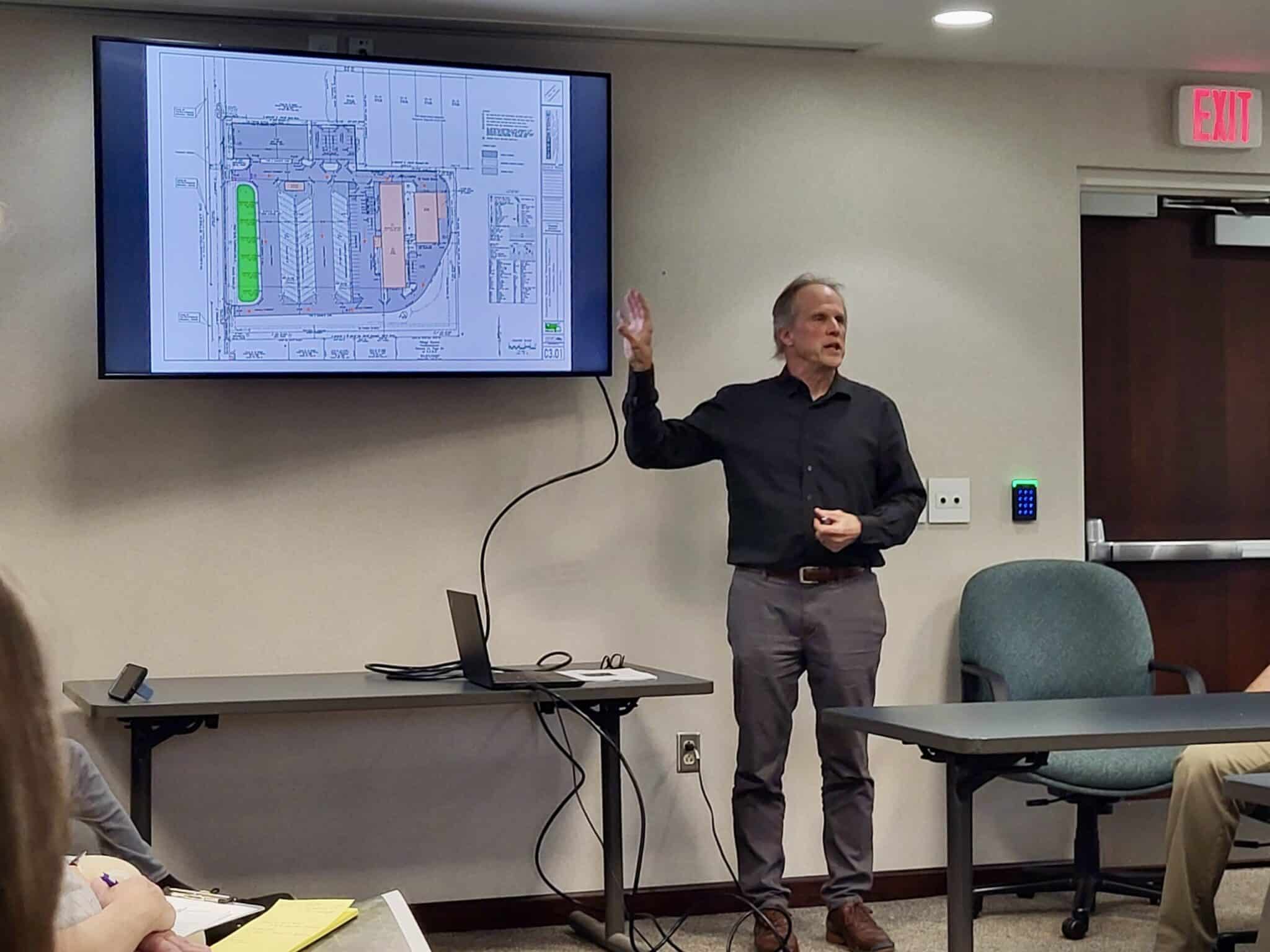
It would include 71 parking spaces for passenger vehicles and employees, as well as 47 spaces for school buses and a fueling station for school vehicles. There are already two buildings on the lot that would be renovated as part of the project.
Attached to the concept plans and architectural review were eight variances. As detailed by Yaney, they ranged from issues with setback to allowance of vehicle storage in a front yard.
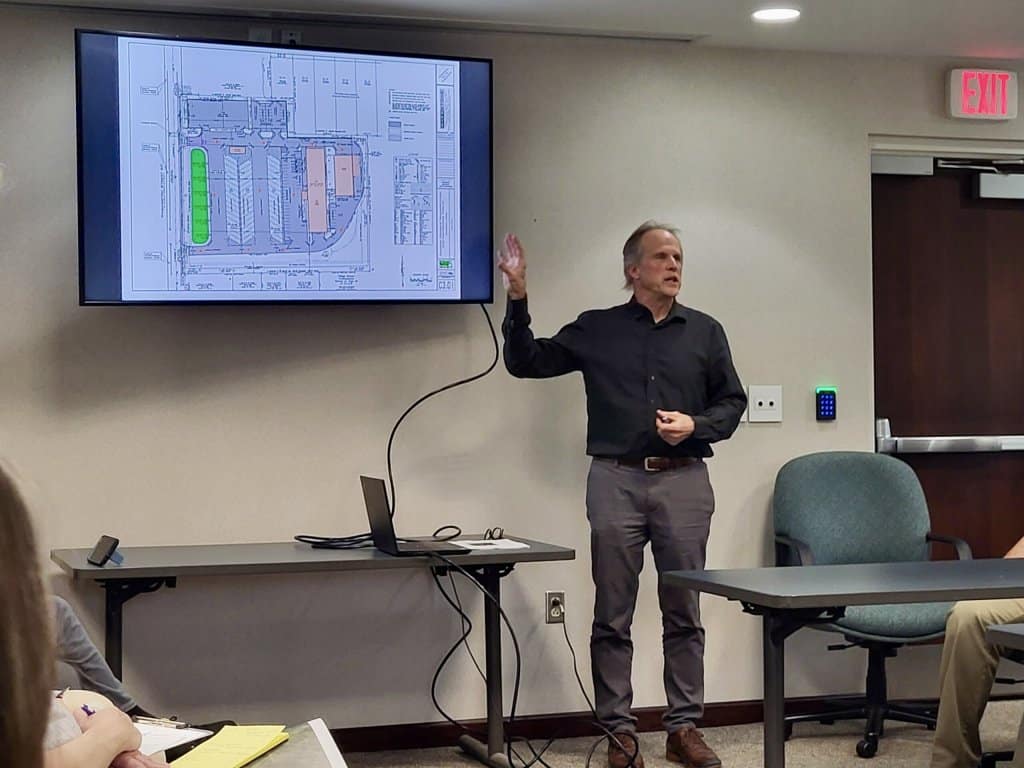
Jeff Henderson, of ThenDesign Architecture, presented the concept plans to the board.
“As you know, the existing bus terminal behind the high school is a safety issue,” he explained. “This is a big step in the right direction to kind of get it away from the school, put it in a campus by itself.”
In addition to transportation, the facility will also house business affairs, which are currently located at Hambden Elementary School, as well as food service, IT and district maintenance, he said.
The two refurbished buildings, referred to on the concept plans as A and B, would house administrative offices, mechanics and bus maintenance. An extended level will also be built onto an existing dock, allowing trucks easier access, Henderson said.
City Engineer Doug Courtney noted a traffic impact study had been recommended in a previous review of the plans and is currently underway.
There will also need to be a consolidation as the proposed property comprises eight separate parcels, he said.
Courtney noted it had been recommended to move the fuel station to the east, a suggestion that had been declined in order to not interrupt bus traffic flow.
Commission member Andrew Blackley said if the fuel station wouldn’t be moved, he would like to see it screened, as it is otherwise visible from the street.
Security is also a major consideration with the facility. Henderson described security gates and cameras mounted on the light poles. An 8-foot opaque vinyl fence will surround the site, with the exception of Washington Street, which will be blocked by a combination of an 8-foot ornamental metal fence and trees. On some sides of the building, the fence will sit above a retaining wall, which is being built to combat erosion.
“Even from a security standpoint, the school district wants to be able to have visibility into there, not have this sort of solid fence that they can’t see what’s going on,” Henderson said.

Traffic Impact Concerns
Blackley called the current lack of a traffic impact study a major stumbling block for approval that evening.
“I’m very concerned how this facility will impact the traffic,” he said, noting Washington Street serves as a major access point to Chardon’s commercial district and the intersections with Water Street and 5th Avenue are already quite busy.
In terms of traffic in and out of the facility, Henderson said buses would enter from one area and exit from another, circulating one way. Primary traffic would be on the west side of the site, away from residents.
Chardon Schools Assistant Superintendent Steve Kofol spoke on the expected traffic flow from the garage.
“The buses do not leave all at the same time. They stagger based on their route time. So, they’ll begin to start exiting the complex between 6 and 7 o’clock in the morning depending upon if they’re a Munson route, a Hambden route and so on,” Kofol explained.
Elementary runs would follow the middle and high school runs, with a few buses returning and a few departing at the change, he said.
The majority of buses would return, staggered, between 9:20 and 9:40 a.m., Kofol said, adding in the afternoon, buses would exit for the middle and high school between 2:10 and 2:20 p.m. The fleet would split, with some buses sent towards Water Street and some sent down 5th Avenue in order to alleviate traffic backups. Buses would re-enter between 4-5 p.m.

Variance Requests
Commission members also expressed concerns about a variance requesting to waive the requirement of 5% landscaping of the parking lot.
The reason for landscaping in parking lots is to mitigate the thermal impact of open asphalt, Blackley said.
“I have not heard a cogent or decent reason as to why we should allow that to happen,” he said. “We require other applicants to do the same thing, so to me, that is an issue.”
Henderson said they are seeking a variance on landscaping in the parking lot in order to ease winter plowing.
Curbs in the lot could impede the movement of snow, especially with plans to move snow to the south side of the lot, he said, adding he was also concerned about damage to curbs or to plants.
“That could be said by every site in the city,” Blackley said, calling the variance a sticking point for him.
Commission member Colin Wantz said he saw plenty of opportunity to add landscaping through the parking lot and thought it would be difficult to plow snow regardless.
Henderson argued the bus garage would encounter issues with landscaping that other large parking lots in the area don’t face.
“A difference between (us and) Walmart is that that (parking lot) opens up at night, there’s nobody there,” he said. “There is always going to be these cars, the buses are always going to be on site.”

Blackley also noted potential storm sewer system contamination from oil and fuel.
With the current parking lot design, there was little opportunity for the separation of oil contaminants from runoff, he said, describing the current design as a sheet drain, allowing the flow of water across the pavement and into inlets along the retention basin.
In response, Henderson asked what is done in other large parking lots like Walmart to deal with contaminated runoff.
“Some of the largest parking lots we have are Walmart and Home Depot,” Courtney responded. “And they have underground retention systems and separate water quality units, manufactured water quality units that handle flows coming out of those retention systems.”
Riverstone civil engineer Joe Drucker described options currently being examined.
“We’re trying to maybe do a filter system kind of behind the curb cuts before it goes into the basin,” he said, noting an underground system was unlikely to work due to the shallow sewers in the street.
They’re currently looking at a system to clean hydrocarbons out of the water, Drucker added.
Light Pollution
Light pollution also posed a problem.
“This will have a lighted parking lot and will be lit at night,” Blackley said. “So, we want to know what the potential for light pollution is from that.”
While photometrics were provided as part of Henderson’s presentation, as they had not been given to the commission earlier, they were unreviewed.
“It’s really important we don’t spill light off the site, particularly with the surrounding neighbors,” he said. “Although there’s a lot of woods around the property.”
Members of the audience disagreed with Henderson’s assertion the property is wooded.
“The intent is, though … that the light spill is negligible at the property line,” Henderson added, explaining the pole heights, fixtures and cutoffs are designed to meet what is required by code in terms of light spill.
The commission approved all the variances except the requirement of 5% landscaping.
The approval of concept plans was tabled due to a lack of necessary information, such as the traffic study and photometric plan.
“I’m not willing to approve a concept plan for a development of this scale without that,” Blackley said.


