


GPH Audit Shows Business Paid For, Did Not Receive Septic Inspections
An audit of three Geauga Public Health data systems showed between 2010 and 2022, the department conducted only about a third of the septic inspections for which it had collected fees, said attorney Bryan Kostura in a presentation April 26.
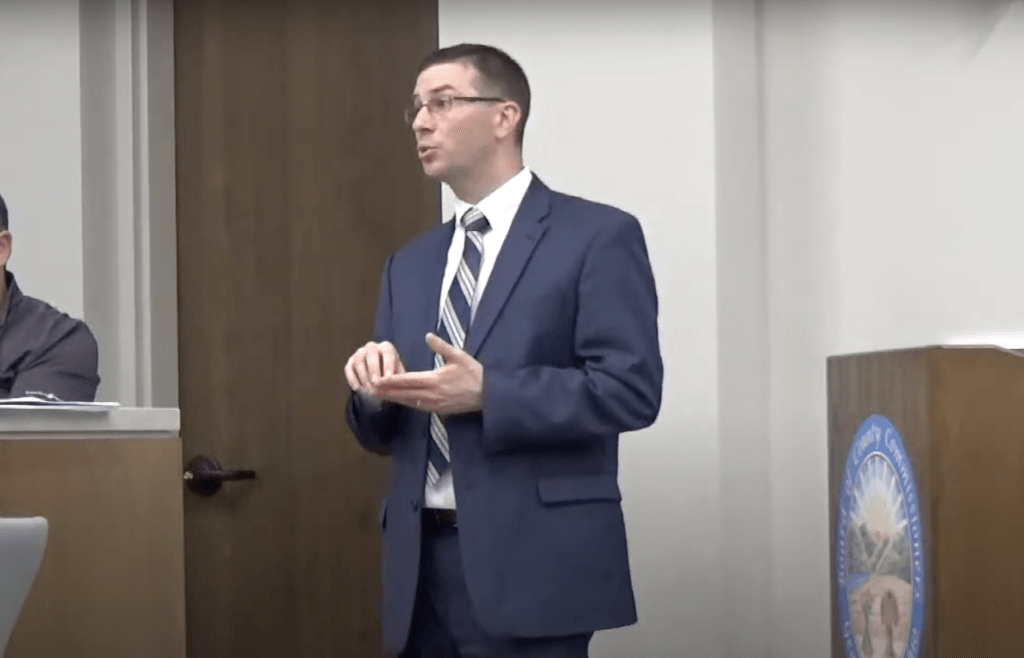
An audit of three Geauga Public Health data systems showed between 2010 and 2022, the department conducted only about a third of the septic inspections for which it had collected fees, said attorney Bryan Kostura in a presentation April 26.
During the Geauga County Board of Health meeting, Kostura, of McDonald Hopkins, said over the 12 years examined in an audit conducted by his firm, GPH collected almost $792,000 in application fees and late fees for inspections at 577 different sites around the county but conducted only 203 of those inspections.
“And I will tell you that 97 of those inspections, they happened in 2022, when GPH staff recognized that there was a deficiency and tried to address it immediately,” he said.
The 203 verified inspections amounted to about $33,000 in fees, which means GPH collected almost $760,000 that was never used to conduct inspections.
Kostura said House Bill 100 was adopted by the Ohio General Assembly in 1984. The bill outlined a partnership between the Ohio Environmental Protection Agency and local health districts to allow local oversight of small commercial sanitary and disposal systems discharging less than 25,000 gallons per day.
Under the program — now commonly referred to as HB 110 — local health departments conduct inspections on behalf of the Ohio EPA and enforcement is carried out by the Ohio EPA and county prosecutors, he said.
Systems included in HB 110 are restaurants, small mobile home parks, businesses, industrial parks, housing subdivisions, apartment complexes, markets and shopping centers, Kostura said.
The two main types of systems the program is used to inspect are off-lot discharge systems and on-site disposal treatment systems.
Kostura described an arduous auditing process, during which his team manually reviewed over 1,000 hard copy files for individuals and cross-checked those hard copies with an on-site database containing records of 471 establishments. Another off-site database held information on 870 businesses.

Kostura said hard records were not well-organized and some contained transcription errors.
Information on some properties was duplicated when original files could not be found, he said.
“So, what we were able to do is go through each and every file,” he said. “We were able to put it in our documentation to substantiate that there was an application, that a fee was paid and whether or not an inspection occurred.”
GPH Administrator Adam Litke said he has been in contact with the Ohio EPA and is sharing results of the audit.
“They may come in and audit us — I don’t know that for a fact,” he said.
Litke said Kostura’s firm conducted the audit to provide a more objective view.
“I’ve done audits in the past, but the problem is when someone has a potential bias, you don’t want them doing the audit,” Litke said. “An outside perspective is what you need.”
GPH board member Dr. Mark Hendrickson asked what led to the decision to perform the audit in the first place.
Litke said he didn’t see any staff going out to perform inspections and when he asked Environmental Health Director Dan Lark to get involved, Lark, too, was unable to find staff performing the inspections.
“At some point, if we find out there’s a small commercial entity that’s just not recognized and has been dumping all sorts of waste, will we have some kind of process to investigate whatever they’re dumping to see if it’s causing a local problem,” Hendrickson asked.
Litke said GPH was still receiving nuisance complaints and is now trying to stay up to date on those.
“So, if you were to call in, as an example, say your neighbor is (improperly discharging sewage), we go out and investigate that,” he said.
Board President Carolyn Brakey said there are two parts to a solution to the problem facing GPH.
“One is, what are we doing going forward? What are the policies and procedures in place … to make this right,” she said. “And then — what do we do to make this right going back? Because people spent $750,000 for inspections they did not receive.”
Litke said while he would leave the legal issues up to the lawyers, the board has a moral and ethical obligation to return the money.
“I don’t see a moral high ground, I don’t see an ethical high ground, I don’t think I could sleep at night if I knew we were just going to say ‘Hey, it’s ours,'” he said.
Board member Lynn Roman said the board discussed at a meeting in March how to handle the situation once they found out the total dollar amount involved.
“I don’t think anybody expected the number to be like this,” she said. “This comes down to — where do we find the money to pay back $750,000?”
Litke said he did not prepare an altered 2023 budget for the board partly due to time constraints, but also because of the recent merger with Lake County General Health District.
“If I put a budget before you and then I change that budget by three-quarters of a million dollars, and we’re a three-million-dollar budget, it looks a little funny that I’ve asked you guys to (make) two massive budget changes two months in a row,” he said.
Brakey asked Kostura about options for refunding fees to businesses who paid for but did not receive inspections.
Kostura said there are companies that specialize in identifying groups, such as those involved in class action lawsuits, and contacting them to arrange refunds or payments from, for example, an escrow account set up by GPH.
“Generally speaking, those businesses can do it far more efficiently than … putting a full-time staff member on it for months at a time,” he said. “They have the programs and the systems in place to make sure that everyone that’s on the list is getting contacted.”


