


Great Lakes Cheese Saga Draws a Crowd
Epprecht Family: Employees as Owners Vital Asset to Company
Geauga Country has more than its share of entrepreneurs and many of them showed up Nov. 17 to hear the story and philosophy behind one of the most successful locally-grown businesses in the county.
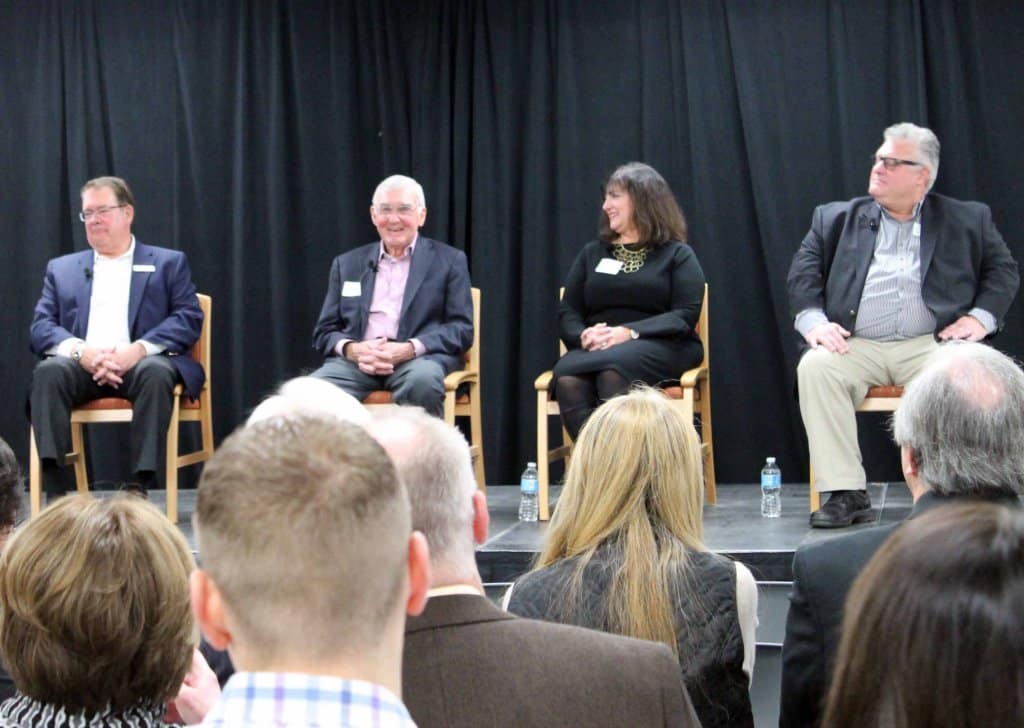
Geauga Country has more than its share of entrepreneurs and many of them showed up Nov. 17 to hear the story and philosophy behind one of the most successful locally-grown businesses in the county.
Hans Epprecht, who founded Great Lakes Cheese out of the back of a panel truck, and his sons and daughter, spoke informally at the Geauga Economic Leadership breakfast at Kent State University – Geauga to a packed room.
Well over 100 attended, hoping to learn how the Epprecht family grew a cheese-packaging operation to a multi-million-dollar corporation with plants scattered across the U.S.
Dedication, grit, timing, networking and innovation all had a part in the 70-year saga.
But, each speaker focused on the most vital facet of GLC’s success — its employees.
Emigrating from Switzerland to Cleveland in 1948, Hans served in the Korean War and came home to work at Brewster Cheese until 1958, when he was hired by the Stark County Milk Producers Coop to deliver cheese out of a panel truck to ethnic shops in Cleveland.
He worked with Hans Rothenbuhler, who was building Middlefield Cheese, and the families are still business partners.
In 1962, he and a partner bought a building on 3 acres on state Route 87 in Newbury Township.
“Today, you could buy half a big semi-truck for what we paid for the land and building,” he told the crowd.
Over the years, Hans added to the building 11 times. His children grew up in the business and are now responsible for specific functions within the corporation.
John Epprecht, who is also chairman of the Geauga Growth Partnership board, recalled sweeping factory floors while his father laid the foundation for an empire.
And he was also the first recipient when his father decided to institute an employee stock ownership plan in 1972.
Heidi Epprecht Ells said the profit-sharing idea came from her father’s concern that employees should have resources to live comfortably when they retired.
“The idea being, whether you are in management or sweeping the floor, you got a piece of the action,” Hans said.
More than 2,400 employees and former employees now own about 20 percent of GLC.
Heidi recalled another reason behind Hans’ stock ownership decision.
“He said ‘I can’t be everyplace at once. I want the employees to be owners,’” she said. “We get many of our best innovations from people on the lines and in the company who have their owners’ caps on. That has been a very important key to our success.”
Kurt said it is a proud moment when an employee retires from GLC after 30 or 40 years and is grateful for the stock they have received.
“If you are a business manager, you can’t do anything more rewarding than that. It’s the secret sauce,” he said.
When new employees learn about the stock ownership plan, they are thrilled, Heidi said, adding there can be issues in retraining a whole company to understand and undertake the employees’ part of the deal.
When it became apparent processed cheese was a part of the market GLC needed, they were pleased when a cheese factory owner in California called to offer them the operation.
“So we had processed cheese, but the challenge was to teach the people our culture,” John said.
While packaging for resale is the largest part of GLC’s business, the company also owns dairies and makes cheese in several locations, with high quality and low cost a priority, Heidi said.
“We make amazing cheese,” she said, but it is often sold under private labels.
So GLC is working to get its name recognized, hoping to get a larger part of the millennial generation market, Kurt said.
“We have an insights group that keeps in tune with our customers,” he said, adding the company has beefed up its sales department.
“Our children don’t eat how we did. There’s a whole different race (for sales) going on,” Kurt said.
That includes attracting new employees from that generation and keeping them engaged, John said.
“Don’t forget to invest in your people … training them, putting them first,” he said to the audience, adding steady employment is a priority with most people.
Because customers want cheese, no matter the economy, GLC has been able to avoid layoffs during slow seasons, but there are still ups and downs in demand.
“We push our people pretty hard, especially this time of year,” John said, adding the company tries to make sure they get 40-hour weeks all the rest of the year, rather than cutting hours or laying off when things are slow.
“That’s how you keep people,” he said.
The Epprecht siblings have been involved in the family business through some tough times, including GLC’s painful growth spurts.
John was vice president of operations, Heidi was sales manager and Kurt was in procurement when GLC was growing fast and Hans and his family had to rethink how to manage their many operations.
“It was a unique time. We were hitting big,” Kurt said. “An entrepreneurial company has to meet the challenge … when having so many locations wears a man out. Hans was eyeing retirement. The company had to make a decision: who’s going to take over for Hans?”
After a memorable meeting, the family decided to hire a CEO rather than one of them trying to take on the job.
Of Hans’s seven grandchildren, three are now in the family business and John. Heidi and Kurt are working toward a succession plan, hoping the younger generation will choose to stay with cheese.
“We’ve worked pretty hard at instilling the culture in our kids. We’ve been pretty successful and we’re proud of them all,” John said, adding they are looking for a system that will keep the family business in the family.
“Heidi and I are going to a lot of family business conferences on how to engage the next generation,” he said.
John talked about Geauga Growth Partnership’s efforts to grow the area workforce through programs for youth in the schools starting in eighth grade, which introduce them to industry and teaching soft skills such as resume writing and interviewing for jobs.
“It really has a huge impact on these young people,” he said.


