


Iacampo Judge Allows Suppression of Testimony
An interview of Former Chester Police officer Nick Iacampo conducted in the early hours of Aug. 7, 2023, will be suppressed from his jury trial after an order from visiting Portage County Judge Larry Enlow.
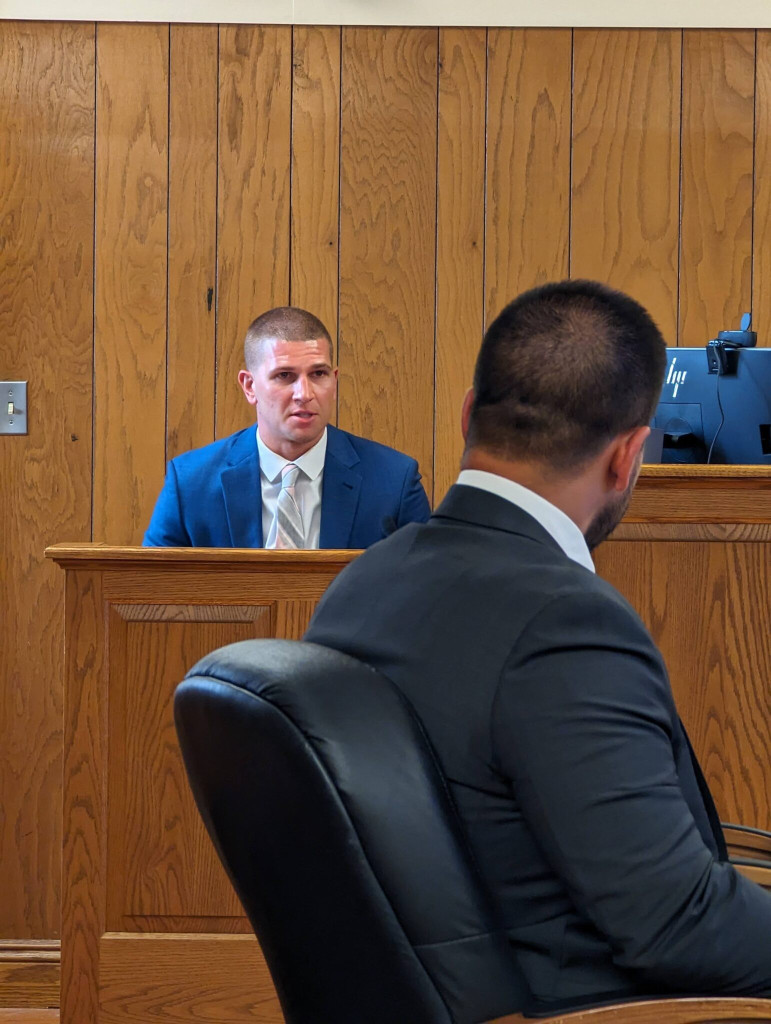
An interview of former Chester Police officer Nick Iacampo conducted in the early hours of Aug. 7, 2023, will be suppressed from his jury trial after an order from visiting Portage County Judge John Enlow.
The interview took place hours after Iacampo, previously a school resource officer at West Geauga High School, was alleged to have sexual contact with a 16-year-old WGHS student in the parking lot of the Church of the Blessed Hope on Wilson Mills Road in Chester Township.
Iacampo was brought to the Chester police station after the student’s father called 9-1-1 from the lobby to report the incident.
In the motion asking the court to suppress Iacampo’s subsequent interview with Detective Dominic Hren and Lt. Larry Harpster of the Lake County Sheriff’s Office, Iacampo’s defense attorneys Ian Friedman and Madelyn Grant repeated his claim from a hearing held May 28 — during which a video recording of the late-night interview was played for the court — that Hren and Harpster did not adequately advise Iacampo of his right to remain silent, or to have an attorney present for the interview.
Enlow agreed.
“The court finds that Detective Hren, prior to questioning the defendant, did not inform him of his right to remain silent. He did inform him that anything he said can be used against him, that he’s entitled to be represented by counsel, if he cannot afford counsel, that counsel will be appointed for him, that he could stop questioning at any time,” Enlow said. “The court would find the confession to Detective Hren and Lieutenant Harpster did not comply with Miranda; therefore, it is suppressed.”
Enlow said the interrogation of Iacampo took place when he was already in custody. In his filing for Lake County Prosecutor Charles Coulson, Assistant Prosecutor Adam Downing said the state agreed Iacampo was in custody, meaning he should have been given his Miranda rights.
But, Downing said Hren did inform Iacampo of his rights, although not in their exact form.
The U.S. Supreme Court has determined that Miranda rights do not need to be read word-for-word to still apply, he added.
“Detective Hren advised the defendant of the following: ‘(S)o l’m a police officer, so I need to warn you, anything you say can and will be used against you in a court of law. You have the right to an attorney here. If you can’t afford one, one will be afforded to you free before any questioning and then you can stop answering questions at any time. Do you understand all that?’” Downing said. “With the exception of the right to remain silent, Detective Hren stated the Miranda warnings almost exactly as stated in Miranda itself.”
Friedman and Grant’s filing said that warning from Hren was inadequate.
“Detective Hren failed to inform lacampo that he had a right to remain silent, which would necessarily include the right to refuse to submit to questioning in the first instance. To the contrary, Detective Hren unequivocally advised lacampo that his participation in the interview was not voluntary, thereby reinforcing lacampo’s reasonable belief that he was required to answer the investigators’ questions,” the filing said. “The failure to specify that Mr. lacampo had the right to refuse to answer questions and/or submit to the interview, when coupled with the other relevant facts and circumstances (e.g., directives from superior officers; advisement that ‘this isn’t voluntary’), naturally created confusion and effectively placed the burden or the correct interpretation on lacampo.”
Additionally, grant and Friedman said multiple courts have said ambiguity could render Miranda warnings invalid.
A jury trial for Iacampo is set to begin Oct. 7.


