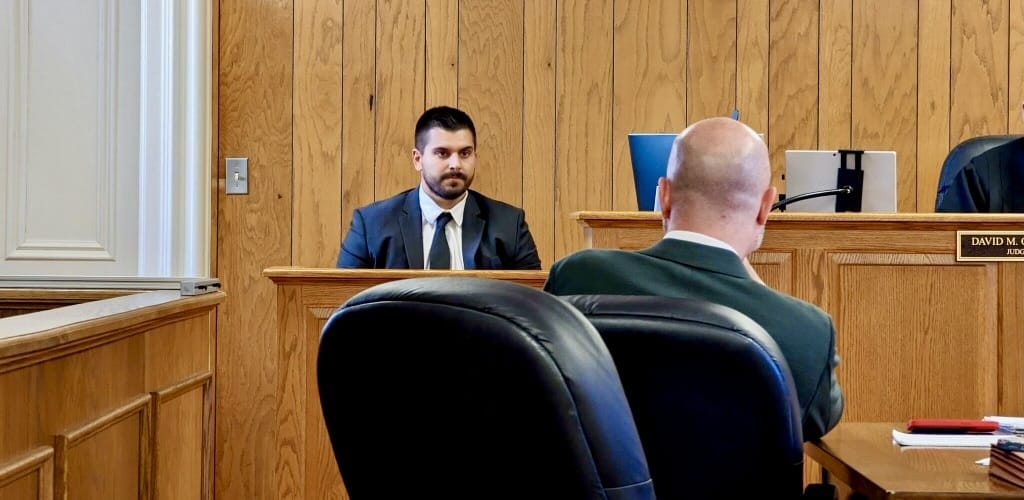
Former Chester Township police officer Nicholas Iacampo will likely face an October trial for a third-degree sexual battery charge and a misdemeanor for contributing to unruliness of a minor after the judge overruled two motions to dismiss charges Aug. 19.
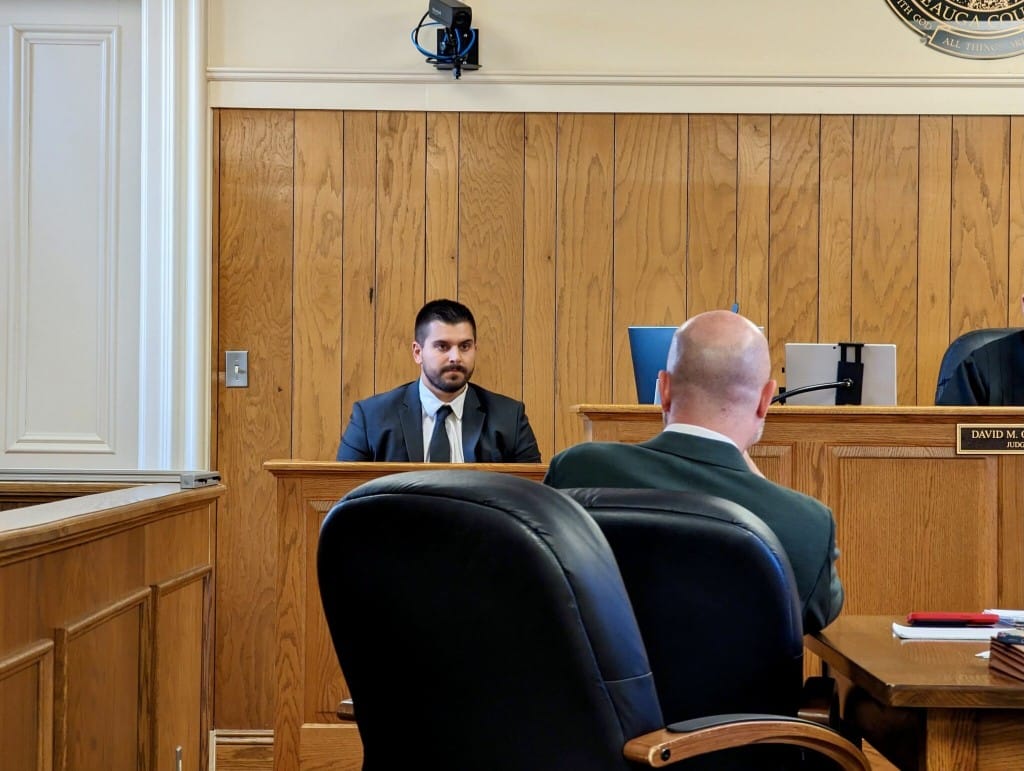
Former Chester Township police officer Nicholas Iacampo will likely face an October trial for a third-degree sexual battery charge and a misdemeanor for contributing to unruliness of a minor after the judge overruled two motions to dismiss charges Aug. 19.
Iacampo, 30, who lives in Painesville with his wife, also served as West Geauga Schools resource officer. His trial is currently scheduled for 8:30 a.m. Oct. 7 in the Geauga County Court of Common Pleas.
The charges stem from an incident that took place in August 2023, in which Iacampo was apprehended after the father of a 16-year-old West Geauga High School student reported the officer had made sexual contact with his daughter.
Iacampo’s defense team, attorneys Ian Friedman and Madelyn Grant, of Cleveland-based Friedman Nemecek Long & Grant, L.L.C., asked visiting retired Portage County Common Pleas Court Judge John A. Enlow to dismiss the charges based on several factors, including that Iacampo’s rights under a U.S. Supreme Court ruling — Garrity v. New Jersey — had been violated during an interview with Lake County detectives hours after the incident took place.
“(Garrity) discusses the difference between a criminal procedure and an administrative procedure and holds that if a person subjectively believes that he’ll be fired for asserting his Fifth Amendment privilege, this belief must be objectively reasonable under the circumstances and requires the court to examine the totality of the circumstances,” Enlow said in his ruling. “The court would find that no time did anyone instruct him that he would be fired from his job if he did not testify.”
Chester Police Chief Craig Young brought in Lake County detectives to conduct a criminal investigation and instructed Iacampo to talk with them, Enlow said, adding Iacampo was later indicted on the sexual battery charge they were investigating.
“The court would find that at no point was an administrative procedure commenced until after the investigation and then, he was just put on paid administrative leave pending the rest of the criminal case,” he said.

Additionally, based on testimony in a hearing held May 14, Enlow said Iacampo had been through a previous administrative hearing related to an automobile accident. That incident did not lead to Iacampo’s termination.
“(T)here was a separate criminal investigation by the (Ohio State Highway Patrol) and then an administrative proceeding against him for that accident,” Enlow said. “The court would find based on the totality of the circumstances that there was not a reasonable belief that (Iacampo) would be fired if he testified. Therefore, Garrity does not apply.”
In another filing the same day, Enlow overruled two other motions brought by Grant and Friedman to dismiss the charges against Iacampo.
One alleged problems with the evidence collected against Iacampo, which Enlow said did not apply, as the indictment against him “is not defective” and these questions are for the jury to decide.
The other was a claim Iacampo — whose case was initially dismissed in municipal court after prosecutors were found to have charged him under a law that did not apply to school resource officers — would be in a double jeopardy situation in a new trial.
That case was dismissed without prejudice and, therefore, does not apply, Enlow said.
In an email Aug. 26, Friedman said Enlow has yet to rule on a motion to suppress statements Iacampo made during what his attorneys alleged was a “coerced” statement to Lake County investigators.
“It remains our position that dismissal of the case was warranted pursuant to legal precedent, but we certainly respect the court’s view and ruling,” Friedman said. “The facts revealed during the hearing made clear that the charged crimes cannot be proven beyond a reasonable doubt. The defense team will be prepared to proceed to trial as scheduled.”