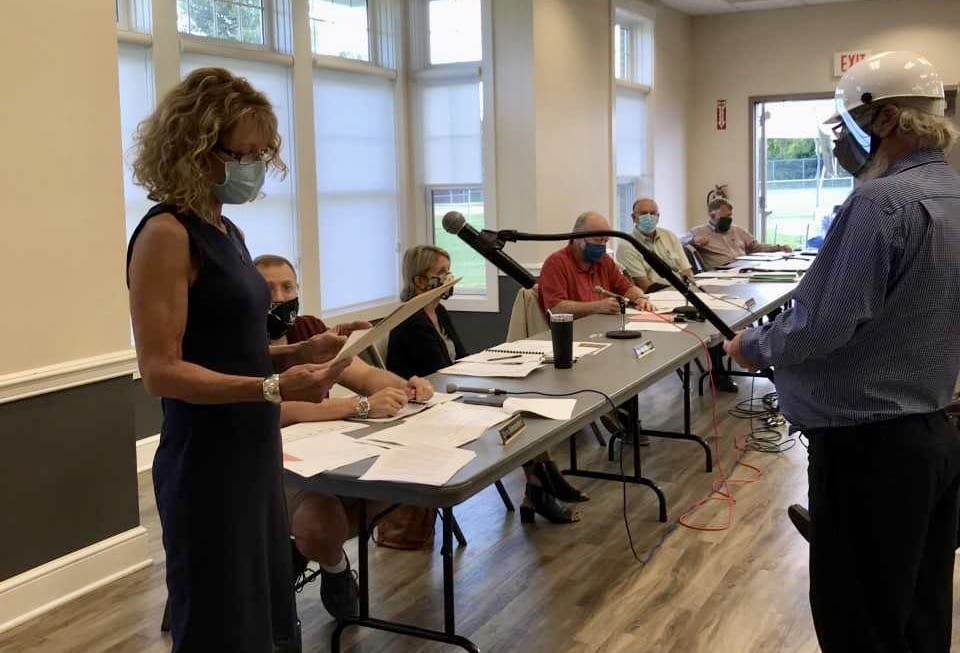
After more than five hours of testimony from various Munson Township residents July 29, the township board of zoning appeals voted unanimously to deny an application for an area variance for an addiction recovery residence on Ravenna Road.
After more than five hours of testimony from various Munson Township residents July 29, the township board of zoning appeals voted unanimously to deny an application for an area variance for an addiction recovery residence on Ravenna Road.
Lake Geauga Recovery Centers CEO Melanie Blasko applied for an area variance in November 2019. She believed the facility for five women at 12700 Ravenna Road was in Chardon and the residents qualified as a protected class, so zoning wouldn’t apply, said township Zoning Inspector Jim Herringshaw.
He asked the Geauga County Prosecutor’s Office for a legal opinion and was told even if the residents are a protected class, the facility is not exempt from township zoning regulations, Herringshaw said.
Chardon attorney Jim Gillette, representing LGRC and Blasko, said a handicapped person is one who has a disability that substantially limits his or her life activities, per the Ohio Fair Housing Act, and that includes individuals with a substance abuse disorder. The five women in the facility will be sober while they are there, he said.
“If they are using, they are not going to be admitted (to the recovery house),” he said. “If they use after being admitted, they are going to be terminated from living there.”
Gillette said the township zoning code discriminates against the proposed recovery house.

BZA Chairman Dennis Pilawa said the board could not address that issue.
“You are trying to bootstrap this into being discriminatory on its face. That’s not what’s before us,” Pilawa said. “It may be your argument (that) it should be, but it’s not.”
Time and again throughout the meeting, Pilawa noted the BZA’s powers are limited to reviewing the facts of the case and ruling on if they meet the eight prerequisites for granting an area variance.
The house in question is in a residential neighborhood and is zoned R1. A change in that zoning would require an area variance that would stay with the property no matter who owns it in the future, he said.
Blasko testified the nonprofit LGRC bought the four-bedroom house in September 2019 thinking the property, which has a Chardon address, would be a good peaceful rural setting for a recovery house.
The five adult women who would be admitted to Twelve Meadows would have to be clean and sober for 30 to 120 days, and active in recovery and the 12-step program, she said.
While there, they would pay rent and be subject to random drug testing. All would be well-screened, Blasko said.
The house manager living at the residence would have been in the 12-step program for a minimum of two years and all new employees undergo orientation, drug testing and criminal background checks.
Blasko said she has set up about a dozen recovery homes in other communities using the same real estate agent each time. However, she said she used a different agent to buy the Munson Township property, so she believed it was in Chardon, which has different regulations about recovery houses.
Currently, Twelve Meadows is occupied by the house manager and one recovering addict, she said.

Residents pay $85 to $95 per week rent and five residents are needed to make the house economically viable, Blasko said.
She explained the facilities all have a good neighbor policy, strict guidelines for visitors and enforced curfews for residents.
“The operation of this facility is not an issue,” Pilawa said. “It’s not one of the factors we take evidence on. It’s a use variance. You can’t go on and on and on about things not being considered by this board. I’m asking you to present testimony in connection with what we need to consider.”
Attorney Patricia Kidd, representing Fair Housing Resource Center Inc. in Painesville, said the Fair Housing Act requires the township to grant an exception to its zoning code because the residents will be members of a protected class.
She and Gillette said they are appealing the zoning inspector’s decision, but Pilawa said the time limit for that appeal expired before it was filed, so the BZA could not act on it.
Munson Township Fire Chief Mike Vatty testified the house doesn’t meet fire code for a group home, so he couldn’t issue a certificate of occupancy if six people are living there.
The meeting started at 6:35 p.m. and, after Pilawa opened it to public comment, dozens of members from the 50-person audience presented pages of opinion and some testimony stating the presence of five recovering drug addicts and alcoholics is widely opposed in the neighborhood.
Several people proposed that increased traffic at the intersection of Waterfowl Lane and Ravenna Road would be a hazard for visitors and children, and said such a facility would lower property values. Others said they felt a recovery house is a business which doesn’t meet the zoning code for the area.
After listening to hours of comments and lengthy written statements from residents on Waterfowl Lane and Ravenna Road, Pilawa and the board members met in a side room for about 15 minutes. Upon their return, he offered some comments and explanation on how LGRC failed to show it met any of the eight elements.
“I’m struck by the absolute lack of evidence that has been presented by the applicant,” he said. “A use variance is not a minor thing. It requires the existence of unnecessary hardship. There is no evidence the hardship claim is unique to this property. It seems to me there is no hardship associated with this property at all.”
The property can still be used as a single family home, he said.
As a recovery house, it would be used by renters who pay weekly, Pilawa said.
“There is no other evidence to suggest this area has any other weekly renter situations or anything other than single family residences,” he said.
The hardship leading to a need for an area variance was self-induced by LGRC because of a lack of due diligence, Pilawa said.
“To grant a use variance, we have to have evidence to satisfy all eight of those required elements. We just didn’t have it,” he said.