Officials warn public schools in Geauga County could cease to function as early as 2027 if a proposed constitutional amendment eliminating property taxes makes it to the ballot and passes — cutting the revenue source that makes up the majority of district funding.
PROPERTY TAXES 101: How Does It All Work?
This is the final installment of a three-part series aimed at breaking down how property taxes work, why they exist, as well as examining property tax reform, what has prompted a state-wide movement to abolish them and the potential impact that could have on various entities in the county.
Officials warn public schools in Geauga County could cease to function as early as 2027 if a proposed constitutional amendment eliminating property taxes makes it to the ballot and passes — cutting the revenue source that makes up the majority of district funding.
Five Geauga County public school districts receive between 55% and 60% of all property taxes collected annually, said Geauga County Auditor Chuck Walder in a Feb. 19 interview.
Those districts — Berkshire, Cardinal, Chardon, Kenston and West Geauga — rely on property tax revenue for between 69% and 76% of their budgets, said all five district treasurers to emailed questions in March.
Petitions to place the issue before voters are currently circulating statewide and require more than 400,000 valid signatures to qualify. The submission deadline is 125 days before the Nov. 4 election, or approximately July 1.
Walder said many taxpayers have questions about how much property tax revenue goes toward education — and they are seeking clear answers.
Ax the Tax Movement Gains Traction
The grassroots “Ax the Tax” movement was launched by Lake County resident Brian Massie, who said his own property taxes increased by 40%.
Frustrated by what he described as a lack of solutions from local and state officials, Massie began advocating for eliminating property taxes altogether.
As previously reported, Massie questioned whether schools are truly locally controlled, pointing to restricted public comment periods and a lack of accountability at board meetings.
Massie proposes shifting responsibility for funding public education and local governments to the state, using alternative revenue sources.
He noted state revenue has continued to climb, while school support — which the state is constitutionally required to fund — has remained flat or declined, leaving districts reliant on levies and placing the burden on homeowners.
“Public school funding is the purest form of socialism,” Massie said, equating socialism with redistribution of wealth by the state.
One idea Massie suggested is consolidating districts into countywide systems. In Geauga County, that would mean merging all five districts into one, which he said could reduce administrative costs.

Push Back
School officials and local leaders have pushed back on that idea.
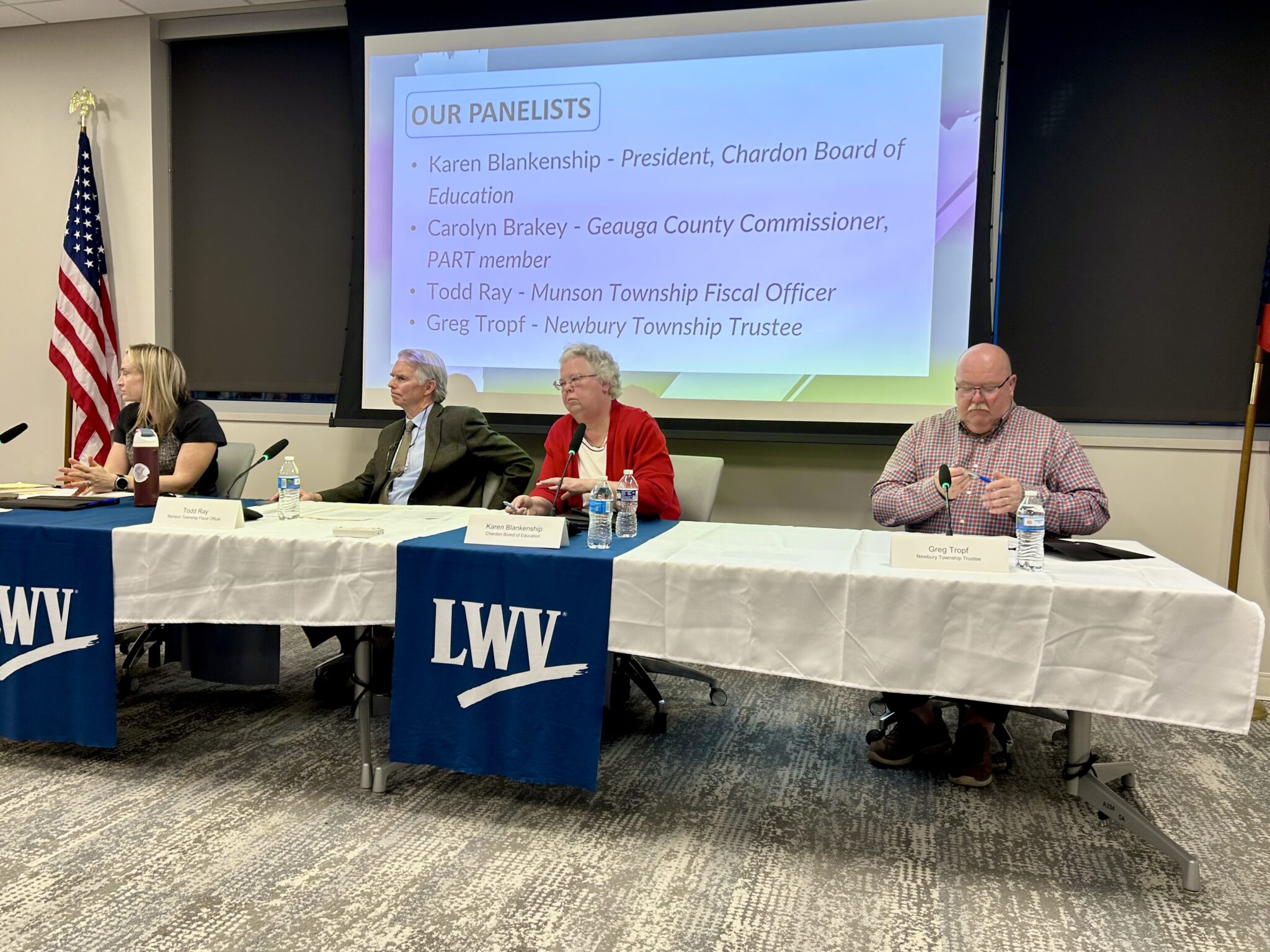
“Merging districts won’t help,” said Chardon Schools President Karen Blankenship during a March 10 League of Women Voters of Geauga forum. “Merging creates technical problems with transportation and unions. It would take a lot of research before districts could start merging.”
Even then, the financial impact remains unclear, she said.
Berkshire Schools Board of Education President John Manfredi agreed.
“You could condense everybody into one district, but if you don’t have the money to operate all (five districts), you don’t have the money to operate one,” he said in a March 24 phone interview. “How would the state fund the schools? We’ve not heard an alternate plan if (property tax revenue) goes away.”
Manfredi added recent legislation aimed at providing tax relief leaves unanswered questions.
“We have to wait until they make these decisions, then we could put it into practice and see what we can afford to do,” he said. “I truly believe they are not going to let the schools close down.”
While the current system of supporting schools is complicated, Manfredi said, in the end, public schools need money to operate and that is up to the Legislature.
“I just want them to fund the schools, I don’t care how they do it,” he said.
Newbury Township Trustee Greg Tropf, speaking at the March 10 forum, recalled how complicated and traumatic it was for residents when Newbury Schools merged with West Geauga Schools, a process completed in 2020.
“It was a tough battle,” he said. “We lost our identity.”
Chardon Schools Treasurer Deb Armbruster noted districts have extensive contractual obligations with vendors for resources ranging from textbooks to energy supply.
“The financial obligations exist. The consequences/options would have to be renegotiated with each vendor, if necessary,” she said.
Geauga County Prosecutor Jim Flaiz warned of potential legal consequences if districts cannot meet those obligations.
“Schools have loans that are tied to taxes,” he said during the forum. “Those folks will expect to be paid. There will be a slew of lawsuits.”
In case of a territory transfer, Armbruster said Ohio law hands land, facilities and buildings off to the receiving district where the students will attend.
“If property taxes were eliminated and a district becomes insolvent, the state would still have to assign the territory to another district and the buildings would follow that reassignment — meaning the assets remain in the public education system rather than being liquidated to residents,” she said.

Longstanding Policy Concerns
State lawmakers have made little effort to address structural issues in school funding, Armbruster said.
The 2023 property revaluation, which significantly increased property values and taxes, lit the fuse on a steadily-increasing pile of dynamite.
“Over two decades of property tax policy decisions by the Ohio General Assembly have shifted the statewide tax responsibility to residential taxpayers who now carry nearly three-quarters of Ohio’s school property tax burden, compared with less than half in the 1970s,” she said.
Cardinal Schools Board of Education President Linda Smallwood said in a March 25 interview the phase-out of the tangible personal property tax on businesses forced schools to find alternative funding sources.
More recently, the Fair School Funding Plan has not been fully funded, leaving anticipated revenue unavailable, Berkshire Schools Treasurer Beth McCaffrey said at a recent board meeting.
Districts must also absorb unfunded mandates, such as transporting students to private and parochial schools, Smallwood said.
“The state has consistently reduced the amount of money we get from them,” she said, adding the tangible personal property tax from burgeoning businesses in Middlefield could have reduced the need for levies in the district.
Smallwood also said questions posed to state Rep. Sarah Fowler during a recent meeting about how schools would survive without property taxes went unanswered.
“It doesn’t sound like the state has any interest in solving this if property tax goes away,” she said.
Meanwhile, she noted, the voucher system, which takes money from the public schools and gives it to private and parochial schools, is alive and well.
“Ohio is poised to spend $2.5 billion over the next two years supporting private schools, including religious schools,” she said.
A Franklin County Common Pleas judge ruled in June 2025 that Ohio’s EdChoice voucher program is unconstitutional; however, the ruling is under appeal and the program remains in place, according to a WKYC article published Oct. 9, 2025.

Districts Project Financial Collapse
School treasurers outlined potential timelines for insolvency if the amendment passes.
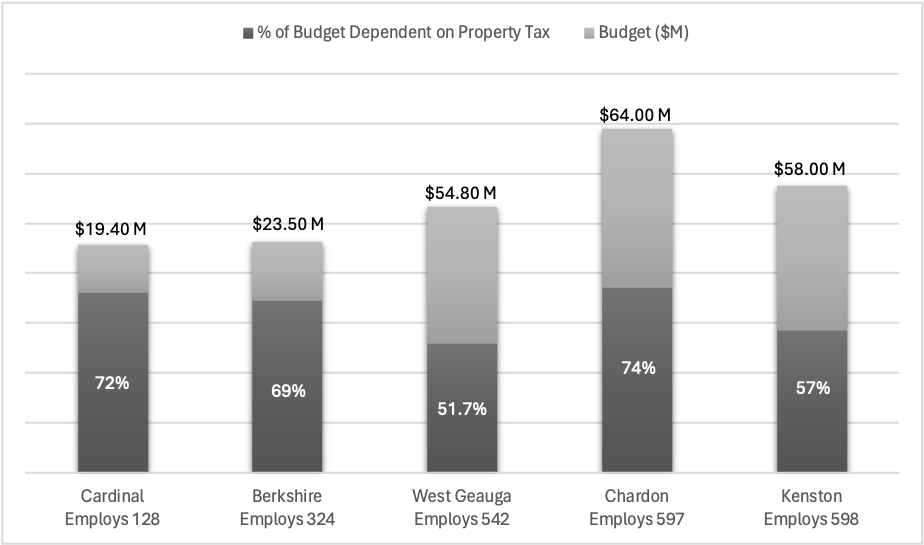
Kenston Schools — which has about 598 employees and has a total budget of about $58 million, 57% of which is dependent on property taxes — faces outstanding bond debt through 2029 tied to construction of its high school, said Treasurer Seth Cales.
“This would be catastrophic to the district,” he said, noting the district could default on its loan.
He explained the state-mandated biannual forecasts are based on the general fund figures while the total budget figures include food service, bond payments, athletics, permanent improvement funds and other accounts.
About 76% of the $42 million general fund comes from property taxes, Cales said.
For West Geauga Schools, 51.7% of its $54.8 million total budget comes from property taxes, said Treasurer Karen Pavlat.
“All district property taxes are directed to the general fund to support daily school operations,” Pavlat said. In other words, 71.5% of the district’s $38.8 million general fund is dependent on property taxes.
“Since the district is debt-free, no taxes are collected for debt repayment. Additionally, as of 2024, the 1-mill permanent improvement levy was moved back into the general fund by the (Geauga County Budget Commission),” she said.
Pavlat said there is a common misconception that school districts can move funds around to balance their budgets.
“The district maintains several ‘restricted’ funds that are legally separate from our main general fund operating budget,” she said. “By law, funds in accounts like food services, capital funds and federal title funds cannot be used for general fund expenses, such as staff salaries or benefits. These funds must be spent for their specific designated programs.”
Currently, the district meets its financial obligations, however, if property taxes were abolished, it would operate at a deficit starting next year, Pavlat said.
“Given spending and expiring fixed-sum levies in 2026 and 2029, we (would) not be able to enter into multi-year contracts such as union or facility contracts,” she said, adding the district, which employs 542 people and has a payroll of about $19.7 million, could run out of money by April 2027.
Berkshire Schools, with a $23.5 million budget, could exhaust funds by spring of next year, McCaffrey said, adding about 69% of the district’s budget comes from property tax revenue.
“Depending upon ballot language, (Berkshire) would be out of cash April 30, 2027,” she said.
The district employs 324 administrators, teachers, substitutes and coaches and would be responsible for unemployment costs, she noted.
Cardinal Schools, operating on a $19.4 million budget, receives 72% of its funding from property taxes and 19.6% from the state, Treasurer Dan Wilson said.
“We assume, if we cease to exist, the contracts (of the district’s 128 employees would) transfer to our successors,” Wilson said.
Chardon Schools — which has a total budget of about $64 million, 74% of which is dependent on property taxes — employs 597 people, with 412 under union contracts through 2028, Armbruster said.
Of the district’s total budget, about $1.1 million is spent on sports and extracurriculars, she said.

Tax Structure under Scrutiny
While Massie noted Ohio’s property taxes are the eighth highest of all 50 states, he may not have considered all the reasons for that status, Walder said.
Walder said the state’s property tax system is complex and cannot be evaluated in isolation.
“You can’t just take one component. You have to look at (taxes) in a holistic fashion,” he said during the recent forum. “The entire tax market needs to be re-evaluated.”
He explained that, while voter-approved levies make up a significant portion of school funding (roughly 71%), unvoted taxes — such as inside millage — automatically increase with property values.
When the 2023 revaluation occurred, values increased around 30% and property taxes also jumped, with schools reaping the benefits, Walder said.
“People were outraged,” he said.
West Geauga returned $1 million to taxpayers following the increase and they were the first in the state and only district in the county to do so, he said, noting more than 60% of Ohio districts operate at the 20-mill floor.
While recent state legislation that took effect March 18 aims to address future tax concern, it does not address the consequences of eliminating property taxes entirely.
If the constitution is amended to prohibit collection of property taxes, that legislation will be moot, Smallwood said.

Alternatives Carry Consequences
Despite many homeowners expressing property tax fatigue, officials say alternative sources of funding could have significant drawbacks.
Smallwood said eliminating public schools would likely increase private school tuition dramatically.
Districts could turn to earned income taxes, but the rates required could be substantial.
Smallwood estimated Cardinal Schools might need a 3.5% to 4% earned income tax, which would affect district residents in Middlefield Village and Huntsburg, Middlefield and Parkman townships.
Increased sales taxes are another possibility, but those could raise the cost of living and affect Ohio’s economic competitiveness, she said, adding it is unlikely customers would pay less for their purchases since sales taxes would boost the cost of everything.
Numerous school officials have theorized some at the state level would like to see a county-wide school district, but Smallwood said the main savings would be the cost of four superintendents, since the existing school facilities and personnel would still be needed, and the communities would lose local control.
As the debate continues and petitions to Ax the Tax circulate, school officials warn the stakes are high — not just for districts, but for the future of public education in Ohio.
~~~
Inside Millage & the 20-Mill Floor Explained
“Inside millage is often referred to as unvoted millage because voters do not approve the first 10 mills or 1% that are levied on a property. The authority to levy these 10 mills are found in the Ohio Constitution,” according to The Ohio School Boards Association.
When referring to the “20-mill floor,” OSBA explains, “The Ohio Constitution has a provision commonly referred to as HB 920, which requires that property tax millage be reduced as property valuations increase to maintain the dollar amount approved by voters. However, if a school district only has 20 mills of property taxes, HB 920 is not applied to the millage, thus preventing districts from falling below the 20-mill floor calculation and receiving additional revenue based on the reappraisal percentages.