


TTH Gives GEL Synopsis of 21st Century CAD
The audience at the Geauga Enterprise Leadership breakfast Oct. 6 was practically spellbound by a video presentation about 3-dimensional printing.
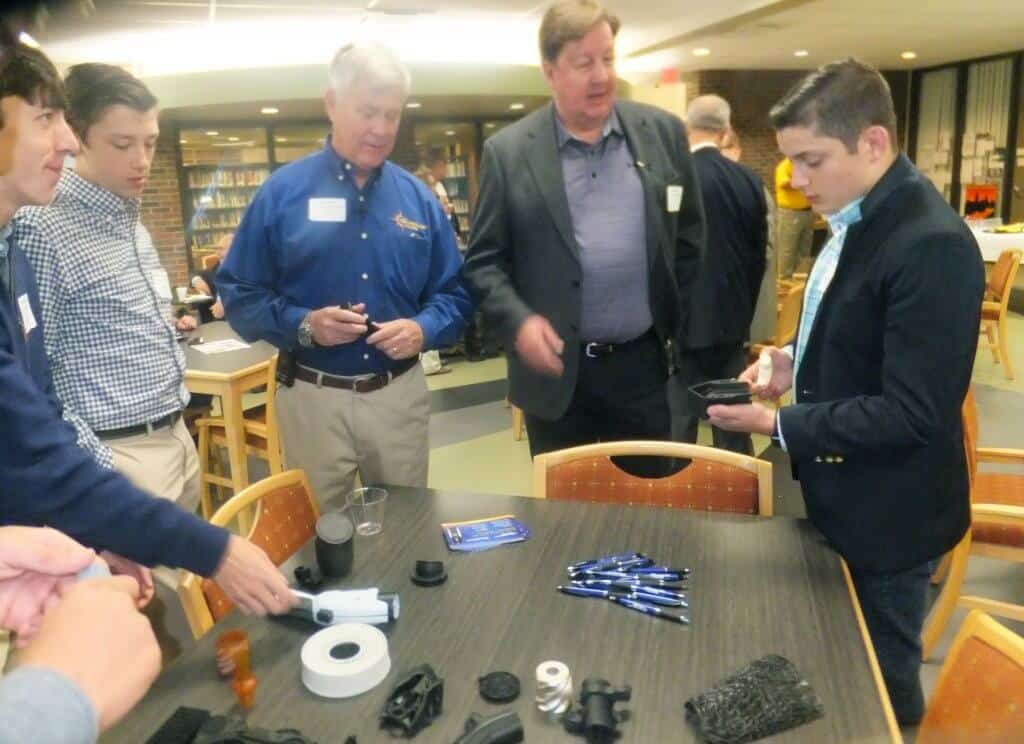
The audience at the Geauga Enterprise Leadership breakfast Oct. 6 was practically spellbound by a video presentation about 3-dimensional printing.
It wasn’t a sales pitch — it was a glimpse into the future of production advances in hundreds of fields.
From Invisalign braces to Hollywood monsters, from experimental parts on the Osprey helicopter to running shoes, The Technology House in Solon has dabbled in all facets of Computer-Aided Design, Computer Numeric Control and 3D printing technology since the ‘80s and doesn’t appear to be slowing down.
In fact, Geauga County native Chip Gear, president of The Technology House, and Mark Horner, vice president of business development, said the company has 75 employees and two facilities helping move Northeast Ohio into the 21st century industry.
“It has really changed the way people manufacture,” Horner said to an audience of 75 at Kent State University – Geauga in Burton Township.
When he still worked at Delphi Packard in Warren, computer-assisted drawing was just getting started and few had any idea it would so drastically affect the injection molding industry, he said.
There have been lots of advances in the area since the ‘80s.
Gear and Horner spoke at length about the technology, from direct metal laser sintering to combining inkjet technology with ultraviolet-curable materials and CNC alternatives.
Emerging technologies such as the game-changing Carbon Clip M1 “allows you to print things you couldn’t manufacture any other way,” Horner said.
Cutting edge technology and materials are making injection-molded plastics obsolete, he said, with athletic shoes being just one example.
“We’ve created a mid-sole that shouldn’t exist,” he said. “This is not a publicity stunt — this is a revolution.”
Ten Olympic athletes were fitted with the super shoes and eight of the 10 chose them over their regular shoes, Horner said, adding the product should be on the market next year.
Craniofacial implants, designed using CAT scans and the new 3D production technology, are reducing surgery time by 30 percent or more and lowering costs of replacing parts of skulls, he said.
An experimental lower-leg prosthesis that acts like a real limb is in the pipeline, he said.
The company that makes Invisalign braces has 60 machines operating 24/7 and turning out 60,000 units a day, thanks to the technology, Horner said.
Masks, costumes and monsters are being created and produced by the thousands, keeping the special effects industry busy supplying Hollywood, lowering the cost of film production and the time involved.
Aerospace, defense, medicine, engineering, oil and gas and the automotive industry can draw an item using CAD, then create it in a vat of material using a laser to move their business ahead at warp speed, Horner said.
“And we haven’t seen the ceiling, yet,” he said.
“We have a lot of fun at what we do,” Gear said, adding he began to get a suspicion CAD 3D was going to be the wave of the future about 30 years ago.
“We thought we were onto something when we started in 1986,” he said.
When he got out of the navy and into the workforce, Gear decided he wanted an early model 3D CAD printer.
“I asked my wife if I could quit my job, buy a machine and start a business,” he said.
Today, the company has 85,000 square feet of production space and a solid niche in the industry, he said, adding his three daughters have found places in the company and he sees them more now than when they were growing up and he was busy nurturing the business.
TTH doesn’t have to look far for a skilled workforce.
“Our number-one employee is a gamer,” he said.
A young person who likes to tinker with equipment and has fast-moving fingers from playing video games is often a good candidate, he said.
College education is optional, but TTH works with Cleveland Community College, as well.
“Some people may not care about CAD, but may be great with their hands. We’re looking for people who are excited, interesting and willing to learn,” Gear said.


