


What we’re hearing is they have a lack of connection with each other. And we challenge that and tell them to put their phones down and connect. – Brian Ayer
In the last few years, Geauga County’s suicide trends have differed from the national trends, said Brian Ayer, director of adult intensive services for Ravenwood Mental Health Center.
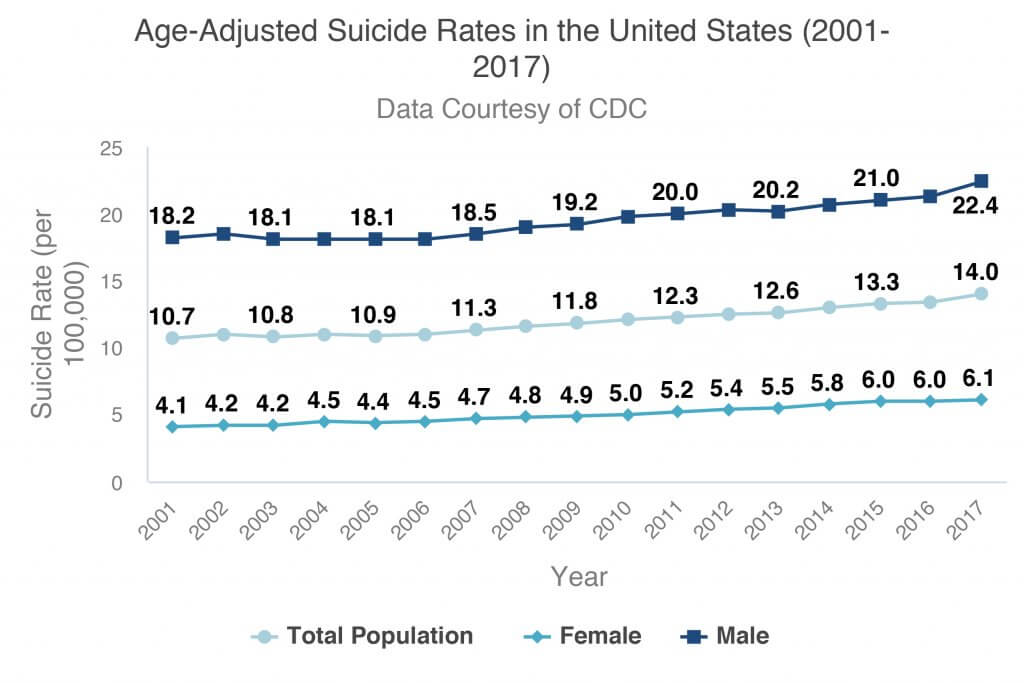
“Our ages are all over the place. The last few years, we’ve kind of seen opposite of the national trend,” Ayer said. “The national trend is middle-aged men, and what we’re seeing is younger age groups and senior citizens.”
According to the Geauga County Health District and Ohio Department of Health, there were 17 reported completed suicides in Geauga County in 2018. Of those 17, 15 were males ranging from 16 years old to 95 years old. Five of the 17 were under the age of 30, while the rest were 47 and older.
In 2019 so far, there have been three completed suicides in Geauga County — a 14-year-old male, 23-year-old male and a 67-year-old male.
According to the National Alliance on Mental Illness Geauga County, the national statistics show two times as many females seriously consider suicide than males, but males actually die by suicide more because their means are more lethal, such as firearms
and asphyxiation.
“Sometimes, it’s just a random occurrence. What we teach in general, in suicide, you’ll hear a lot that depression is a very common theme, which it is, but the number one contributing factor to someone completing suicide is a loss of hope,” said Ayer, who is co-chair of Ravenwood’s suicide prevention coalition. “Sometimes, for young people, it’s, ‘I’m not going to have the life I want.’ And for senior citizens, it’s, ‘I’ve lived the life I want. I’ve lost my influence. I’m not needed in my job anymore,’ . . . so when there is a loss of hope, that’s when we get very concerned.”
Teen suicide has also been on the rise in the county.
“Last summer, the striking change was suicide for teens and young people was always third and now it’s the second leading cause of death,” Ayer said, adding social media has definitely contributed to the problem, particularly heightening the feeling of not being included in certain social events or seeing people seeming to be happy when, in reality, they are not.
“It’s literally changing the brain chemistry of kids,” he said. “What we’re hearing is they have a lack of connection with each other. And we challenge that and tell them to put their phones down and connect.”

Ayer said on the other end of the age spectrum, when people who were very influential and/or had high positions in companies retire, they feel they’re not worth anything anymore, or, if they receive a grim medical diagnosis, instead of waiting it out and putting their family through it, they decide to take their own lives.
“It’s important to have ongoing contact with loved ones to let them know they still matter and are still important,” he said.
He said oftentimes, when a person finally makes that decision, they are at peace with it. “We get concerned because it makes sense to them and we want to prevent them from getting to that point,” he said. “And older people use means that are more lethal, so their rate of completing suicide is higher.”
He said the national statistics show for every attempt of suicide in the elderly, there’s one completion.
“So that’s a 25 percent completion rate,” he said.
The suicide prevention coalition works to identify key areas to develop training for various agencies in the county, such as law enforcement and first responders.
The coalition trains officers for wellness checks, said Ayer, who is also a coordinator for crisis intervention training.
“We’re just trying to get the word out, doing ongoing training and making people aware that there is hope,” Ayer said. “We can get them through these times.”
He said his team also wants to get people to understand and take it seriously when they hear someone say “suicide.”
“We’d rather over respond than not respond,” he said. “Don’t blow it off. The key is we want to instill hope that as hard as things are, and they might be, there are always things to get through it and there are always things here for them.”
Jim Adams, executive director of the Geauga County Board of Mental Health and Recovery Services, said the suicide prevention coalition is currently targeting general practitioners to teach them how to screen potential individuals who might be thinking about suicide or have depression or other symptoms.
The American Association of Sociology reports 45 percent of individuals who die by suicide visit their primary care physician within one month of their death and 20 percent visit within 24 hours of their death. This “last medical contact” before suicide is even higher among the elderly, with almost 50 percent of suicide victims having seen their doctor within the past week.
“The vast majority of those who died by suicide did not get any mental health services prior to their death from the county’s services,” Adams said. “People generally see their family practitioner prior to dying. The numbers are pretty amazing.”
Adams confirmed Ayer’s take on the county’s trends, indicating the senior male population statistics, in particular, are “pretty startling.”
“(Men) 60 and over, there’s a pretty high percentage of those individuals from 2018,” he said. “That’s something that we really need to look at closely on how we are able to impact those numbers.”

With regards to suicide rates in children and teenagers, Adams said the mental health board has been working more and more with school superintendents and schools throughout the county to identify mental health issues in students earlier, as well as on how to impact those students even before they get to that point.
“It may mean prevention and intervention programs at the elementary school level to get in front of it,” Adams said. “Other schools have some well thought out prevention programs, even at elementary schools, that have that ability to stay with a person through high school and into adulthood. Those preventions make a difference for a lifetime. Those are some of the things we are talking with schools about that have an influence with students through elementary school, high school and college.”
Adams also mentioned mental health first aid, offered through the National Alliance on Mental Illness Geauga County, which trains people how to intervene when they believe a teen has a mental health problem.
Adams did point out accidental deaths, suicides and overdoses are interchangeable when statistics are put together.
“Sometimes an overdose is a completed suicide and sometimes it may be accidental,” he said. “So, I think it’s important to address the issue, but we want to know what we are addressing. The bottom line is, we want to make sure we’re doing everything we can to stop those deaths from occurring no matter what their cause or initial issues are.”
Adams said the board is also looking at introducing the PAX Good Behavior Game to school districts, which has shown a positive impact on students’ mental health, graduation rates and reduced interactions with the court system.
“We are also talking more and more with schools about introducing mental health therapists and case workers into the school setting. For example, if a child is having behavioral issues in the classroom that are disruptive to the classroom, we can put a person into that school that can be either in class or out of class with that student (to work on) the issues that create that behavior,” Adams explained. “To get to the bottom line issues that are impacting a student’s ability to learn, that’s what we want to be able to do.
“I think teachers and school districts are learning more and more that it’s not easy to teach in a class where you have a disruptive student who is not able to get the treatment and intervention they need that will be able to help them learn and the rest of the class learn.”
NAMI Geauga County continues to work to eliminate the stigma around suicide through various educational programs it offers to schools, churches, businesses and organizations throughout the county.
NAMI has been working to change the language around suicide. Examples include saying “completed suicide,” “died by suicide” or “took his or her life” versus “committed suicide” and avoiding words like “successful” or “failed” when referring to suicide.
The organization offers support and resources for anyone struggling with any mental health problems, said Jenn Bartone, executive director of NAMI, adding she has been providing suicide in the workplace presentations to educate the middle age and higher demographic of men, and has reached out to other businesses, churches and organizations who fit that demographic.

She is also focusing on mental health first aid for emergency responders, who tend to be more at risk of dying by suicide than dying by the risks of their jobs, according to national statistics.
NAMI offers its Ending the Silence program, which is a school presentation that talks about mental health and suicide and includes a testimonial at the end that works to lower the stigma around it.
“Bringing about education and awareness to everybody is our goal at NAMI,” Bartone said, adding the conversations need to address all demographics and need to be as frequent as discussions about cancer and other diseases.
“We’ve also started a program called Growth Through Grief, a suicide survivor support group, but (we) also added traumatic death (to it),” she said. “I think that, in general, having a support group for traumatic loss here in the county is new.”
NATIONAL SUICIDE PREVENTION LIFELINE
1-800-273-TALK (8255)
COPELINE
1-888-285-5665 or 440-285-5665 to access a Crisis Intervention Specialist.
Text the keyword 4hope to 741 741 and expect a reply from a trained Crisis Counselor within five minutes. Your message is confidential, anonymous and secure.
NAMI HelpLine
1-800-950-6264
For a list of additional resources visit: https://namigeauga.org/crisis-info/


