


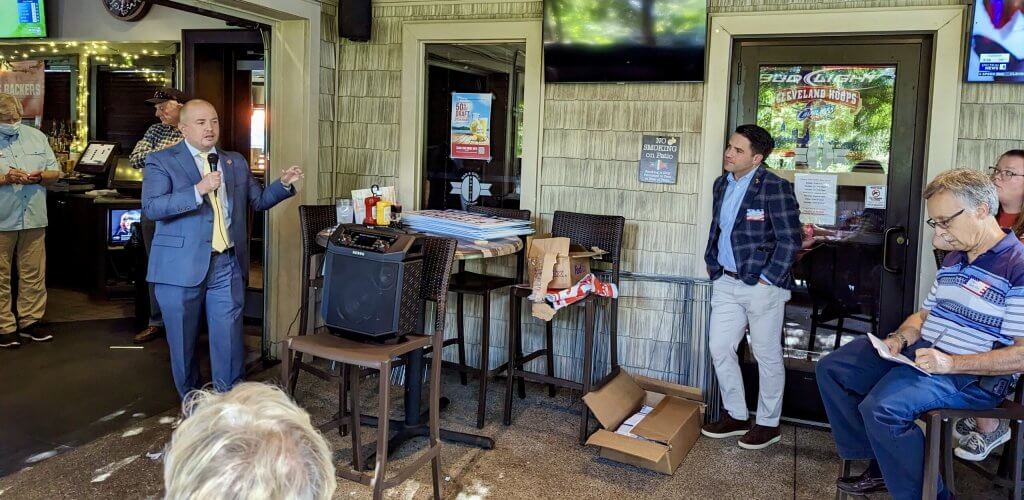
Making a special trip up from his home in Southern Ohio, Republican state Rep. Brian Stewart visited Geauga County July 12 to argue his case in favor of Issue 1.
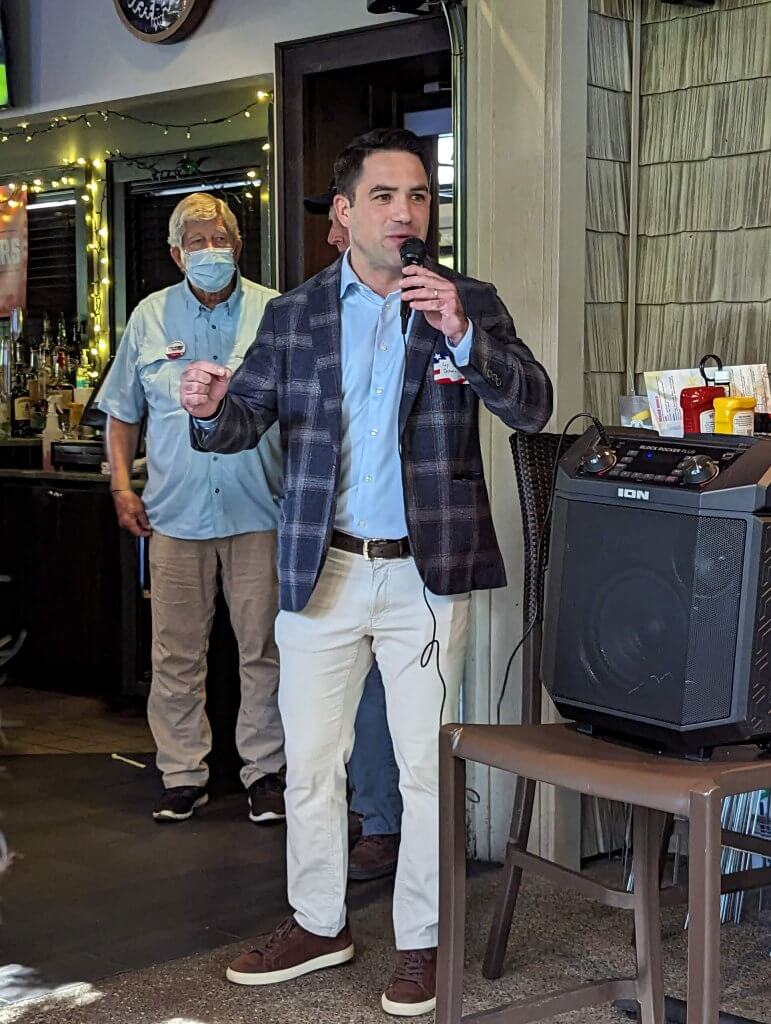

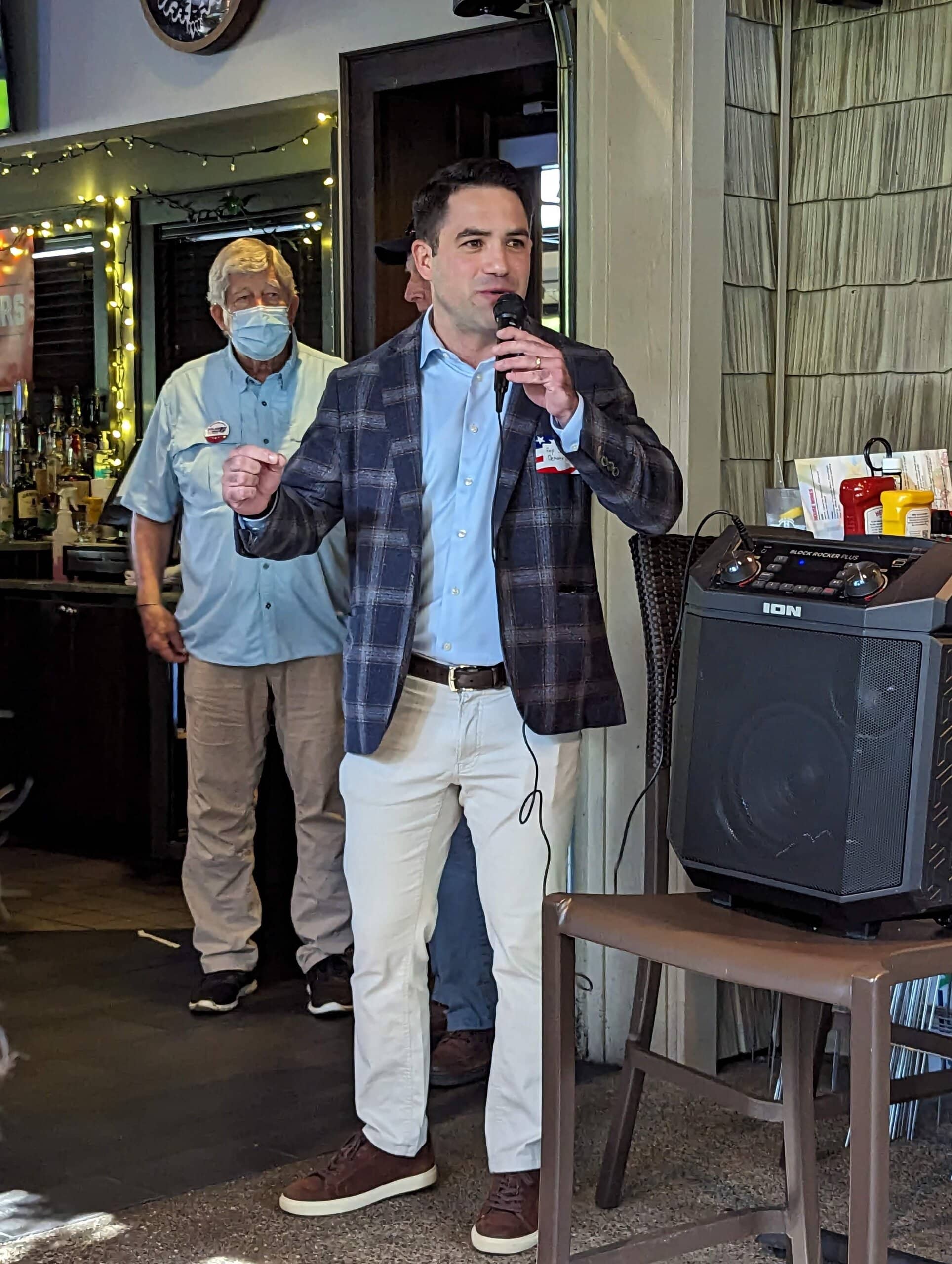
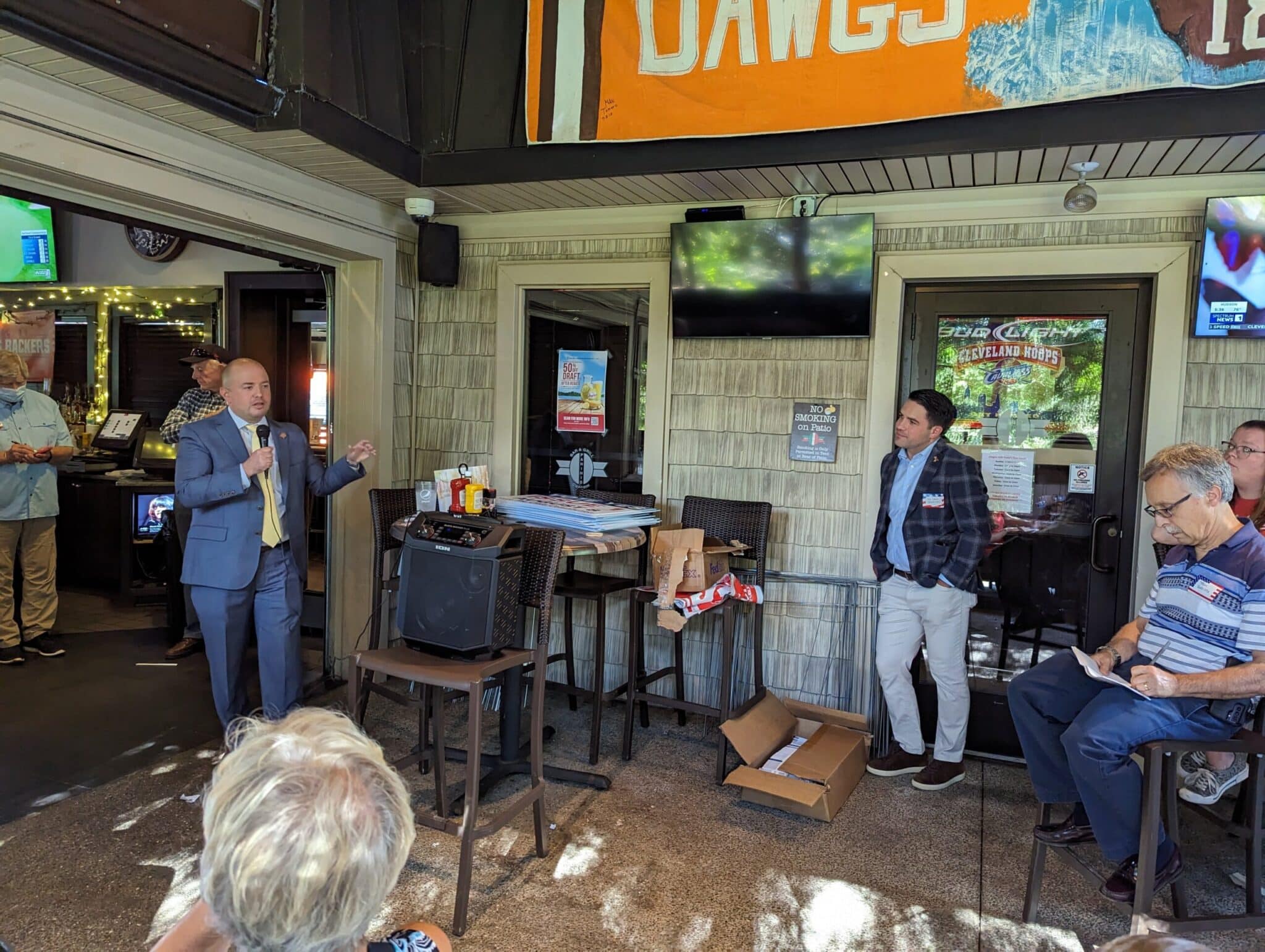
Making a special trip up from his home in Southern Ohio, Republican state Rep. Brian Stewart visited Geauga County July 12 to argue his case in favor of Issue 1.
State Rep. Steve Demetriou, who represents portions of Geauga County, introduced Stewart at an evening event hosted by the Western Reserve Women’s Republican Club at Panini’s in Chagrin Falls.
“I know the word ‘friend’ gets tossed around pretty loosely in Columbus, but this guy is an actual friend,” Demetriou said. “I’m really glad he’s here up in Northeast Ohio to talk to us about a really important issue.”
For Geauga residents, the issue will appear alone on the Aug. 8 ballot after the General Assembly moved last December to eliminate the special election with the sole exception of emergency school district funding issues.
Gov. Mike DeWine signed the bill to suspend August elections in January with the intention for it to go into effect April 7. However, on May 10, Secretary of State Frank LaRose said the election was reinstated by the GA for the purpose of introducing Issue 1.
“The proposed amendment requires any future constitutional amendment to be approved by at least 60% of the voters,” LaRose wrote in a May 10 directive issued to all boards of election in the state.
LaRose said the issue proposes an amendment that would make two changes to the initiative petition process for proposing amendments to the state constitution.
The first would be to eliminate the 10-day cure period to gather additional signatures. The amendment would also require petition signatures from at least 5% of the electors of all 88 counties in the state, instead of half of the counties, LaRose said.
“If the proposed constitutional amendment is approved by a majority vote of the electors, it takes effect immediately. However, the new requirements for initiative petitions proposing constitutional amendments would first apply to petitions filed on or after Jan. 1, 2024,” LaRose said.
In his remarks, Stewart said journalists around the state have accused the state GOP of mischaracterizing the reinstatement of the August election.
“There they go again, those dastardly Republicans, they’re having August special election. Don’t you know that they just eliminated August special elections … and then here we are having another August special election,” Stewart joked with the crowd. “Folks, nonsense. We did not eliminate August special elections. Why? We cannot do it.”
Stewart said the Ohio constitution explicitly allows the state legislature to run a special election whenever they decide one is necessary.
“We did not eliminate the ability to hold an August special election. Here’s what we did do. We did say that we are not going to have the ability to put on a standing August special election, every single year, in one corner of one county, for one school district, to try to pass a property tax levy by you when you didn’t know,” he said.
Jen Miller, director of the League of Women Voters of Ohio, said her organization is concerned a lot of Ohioans will not be aware of a special election. Miller said passage of Issue 1 would mean any proposed amendment on the fall ballot would then have to pass with at least 60% of the vote.
“Bottom line, in the 200-year history of Ohio, the Ohio legislature has never put an issue of such grave importance in an off-season election like August,” she said in an interview. “My concern is that a lot of Ohioans won’t even know that there’s an election, let alone that their freedom to determine their futures through ballot initiatives is at stake.”

For or Against?
A handout produced by LWV-Ohio presents arguments both for and against Issue 1, which Miller said is in line with the league’s “tri-partisan” makeup of democratic, republican and independent voters.
For those wishing to vote yes, the league said the issue could protect the Ohio Constitution by making new amendments more difficult to pass. The issue could also encourage a smaller state government by making it more difficult to raise funds through statewide bonds, which do not allow spending beyond the $750,000 debt limit as mandated in the Ohio Constitution.
Other arguments the league offered for those in favor of the issue include it would prevent people who are gathering signatures from cherry-picking friendly counties, since all counties would need to meet the threshold for viable signatures.
“(Issue 1 would move) Ohio closer to the policy of 32 states that do not allow citizen-initiated constitutional amendments and (match) Florida’s 60% approval threshold for all constitutional amendments,” the league handout said.
As for reasons to oppose the issue, the league said it would end the principle of majority rule, by permitting 40% of the voters to block state constitutional amendments. It would also reduce the ability of the state to raise funds for conservation, economic development and technology projects through statewide bonds.
“(Issue 1) permits the voters of any county to have a virtual veto over citizen-led constitutional initiatives by requiring signatures from all 88 rather than 44 counties,” the league said. “(It) eliminates the ‘cure period’ that gives citizen-led ballot initiative campaigns an additional 10 days to secure signatures if they come up short; makes the use of citizen initiatives to propose amendments to the Ohio Constitution prohibitively expensive and only available to a few well-funded special interest groups; (and) greatly increases the difficulty for Ohioans to use the initiative power when the Ohio government is unresponsive or corrupt.”
The league said the issue is also unnecessary because Ohioans have used their initiative power judiciously, approving only 19 of 71 proposed amendments over 111 years and, in 2015, approved an amendment prohibiting businesses from using the initiative process to obtain any special benefit.
But in his remarks, Stewart said the constitution is supposed to be made up of broad principles that unite the public.
“It’s not supposed to be a vehicle for the fringe ideas,” he said. “If we were to wake up tomorrow and read that Mike Bloomberg — or, you know, take your pick of billionaires you don’t like — was going to spend millions and billions of their own money to attempt to circulate petitions to amend the United States Constitution by popular vote, we would think that is crazy. We shouldn’t be putting our freedom of religion or freedom of speech, our freedom of the Second Amendment up for a nationwide popular vote. That’s never been the way we do things.”
Stewart said the last three campaigns to amend the state constitution spent more than $50 million.
“Trying to buy policy in our governing document is a lucrative business,” he said. “And the special interest groups see Ohio as a very easy mark.”

Abortion on the Ballot?
Stewart called groups opposing Issue 1 over the requirement that new constitutional amendments must meet at least a 60% threshold hypocritical.
“This is opposed by the Ohio Democratic Party. Anybody want to take a guess at what the threshold is to amend the constitution of the Ohio Democratic Party? 60%. This is being opposed by the AFL-CIO,” he said, referring to the American Federation of Labor and Congress of Industrial Organizations. “Anybody want to take a guess what the threshold is to amend the constitution of the AFL-CIO — 66%. This is being opposed by many Ohio’s teachers unions. Anybody want to take a guess what the threshold is? 75%, for the Northeast Ohio Education Association.”
Stewart also called out the LWV-Ohio, which he said requires 66% approval before amending their governing documents.
“It’s almost as if, folks, that these organizations believe that their governing document, the broad principles that are supposed to define their organization, should require something more than 50% plus one and should … require a broader level of buy-in and support before they become effective,” he said. “What a concept.”
But Miller said Stewart’s comparison is not an apple versus an orange. One of the league’s concerns is one county could block the will of all 87 other counties in Ohio.
“One local league or one state league cannot block proposals that the rest of the membership supports,” she said. “We are talking about a membership organization that doesn’t have dark money influences and ultimately works for consensus in everything we do.”
Miller added the impetus for Issue 1, as proposed by Stewart and LaRose, is to “change the rules for the game over one issue” — namely the future of abortion rights in Ohio, which is “utterly shameful.”
She referenced a statewide ballot initiative launched earlier this year to enshrine reproductive rights into the state constitution, which will likely appear on the ballot this November if signatures gathered around the state meet the necessary threshold. But in his comments last week, Stewart said Issue 1 is not solely about abortion — it applies to all constitutional amendments.
“When I introduced Issue 1 — and you know, the media never wants to give you any credit for this — but there was no abortion amendment,” he said.
Stewart said the idea for Issue 1 actually grew out of a four-year study by the legislature’s Constitutional Revision and Updating Committee, made up of equal parts Democrat and Republican.
“The subcommittee looking at how we amend the constitution made a recommendation that we elevate the threshold from 50% to at least 55% for a constitutional amendment. That was made up of Democrats of Democrat legislators,” he said. “The issue hasn’t changed. It’s just the focus on this one particular issue.”
However, in December, Cleveland.com reported Stewart issued a letter to house GOP members laying out his reasons for introducing the issue.
“After decades of Republicans’ work to make Ohio a pro-life state, the Left intends to write abortion on demand into Ohio’s Constitution. If they succeed, all the work we accomplished by multiple Republican majorities will be undone,” Stewart wrote at the time.
Miller supplied the Geauga County Maple Leaf with a copy of the constitutional subcommittee’s report, which she said concluded there was not bipartisan support to raise the passage rate for constitutional amendments to even 55%, while Issue 1 aims to raise it to 60%.
“We have had this freedom (to amend the constitution) in Ohio since 1912,” she said. “This is a check on power for when the Ohio government is not acting in our interest.”


